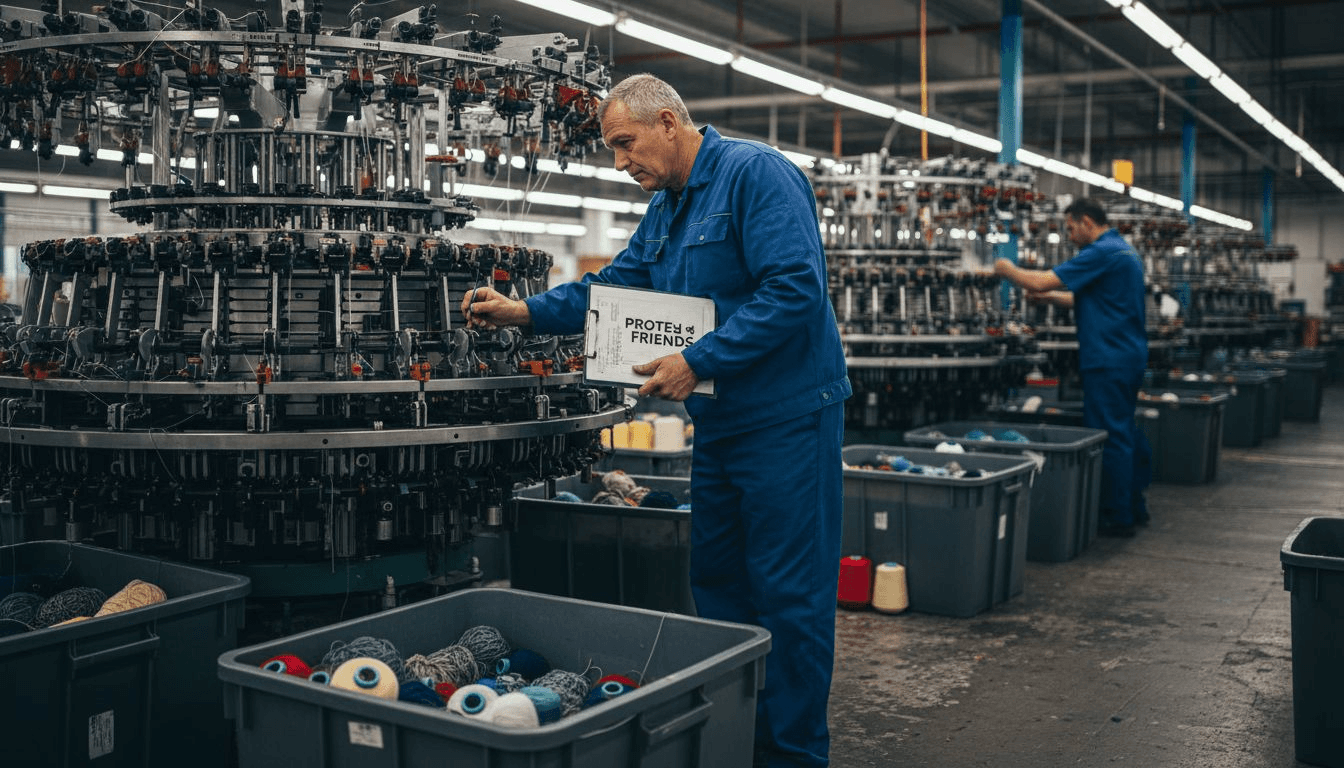
Most fashion brand owners assume knitwear production works like standard cut-and-sew apparel. It doesn't. Knitwear requires specialized knitting machines, unique linking techniques, and fundamentally different quality control processes. Without understanding these distinctions, you risk costly production delays, fit failures, and margin erosion. This guide explains knitwear production workflows, quality measures, and communication strategies that reduce errors and protect your brand investment.
Table of Contents
- What is knitwear production?
- The knitwear production workflow
- Quality control in knitwear production
- Hybrid manufacturing models: USA and overseas advantages
- Common misconceptions about knitwear production
- Fabric sourcing and materials in knitwear production
- Fit correction and sampling
- Communication and transparency between brands and factories
- Case studies in knitwear production
- Summary and practical steps for brand owners
- Partner with Protek & Friends for structured knitwear production
- FAQ
Key takeaways
| Point | Details |
|---|---|
| Knitwear uses specialized machines | Production relies on circular knitting and linking equipment distinct from cut-and-sew processes. |
| Structured workflows reduce errors | Documentation decreases pattern and fit errors by 40% and improves predictability. |
| Hybrid models balance cost and quality | Combining U.S. sampling with overseas bulk production offers cost savings and faster market entry. |
| Quality control prevents failures | Inline checkpoints and fit corrections catch defects before bulk production begins. |
| Transparent communication improves delivery | Clear protocols increase on-time deliveries by 20%. |
What is knitwear production?
Knitwear production constructs fabric using knitting machines rather than cutting pre-woven material. This process creates garments like sweaters, cardigans, and knit dresses directly from yarn loops interlocked by circular knitting machines. The fabric forms as the machine knits, eliminating the need for cutting patterns from bolts of cloth.
Circular knitting machines and linking equipment are essential to knitwear manufacturing. These machines create tubular fabric or flat panels that require specialized seaming techniques called linking. Linking joins knit panels with nearly invisible seams that maintain fabric stretch and durability. Over 50% of knitwear garments require specialized linking or seaming beyond traditional cut-and-sew methods.
Cut-and-sew apparel starts with woven fabric sheets cut into pattern pieces and sewn together. Knitwear skips the cutting step entirely. The knitting machine produces shaped panels or complete garments that only need linking and finishing. This fundamental difference affects production timelines, quality checkpoints, and technical specifications.
Understanding these distinctions prevents common misconceptions that lead to production errors. Brand owners who treat knitwear like woven garments often experience unexpected delays when their tech packs lack knit-specific details. Machine types, gauge specifications, and linking requirements must be documented clearly to avoid costly sampling rounds.
These production differences create unique quality control challenges. Dropped stitches, uneven gauge, and linking failures rarely occur in cut-and-sew but represent major knitwear defect categories. Your manufacturer needs specialized equipment and trained technicians familiar with knit fabric behavior and finishing techniques.
The knitwear production workflow
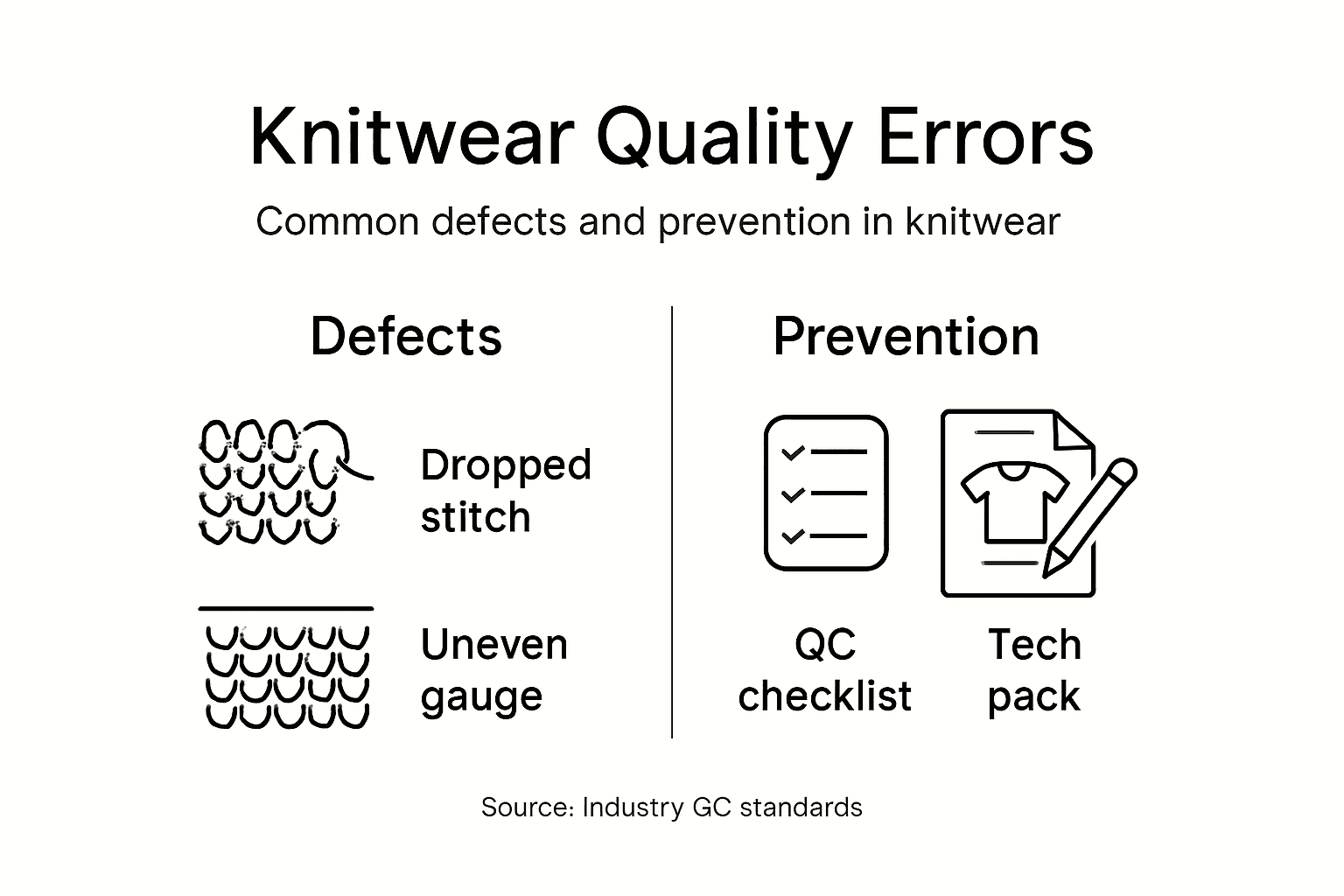
Knitwear production follows a structured sequence of steps designed to minimize errors and control costs. Each stage builds on documentation from the previous phase, creating a clear production roadmap. Skipping steps or rushing through reviews creates compounding problems downstream.
The workflow includes these major phases:
- Design and technical review to validate pattern feasibility and knit construction
- Fabric sourcing and sampling to test yarn quality and gauge accuracy
- Fit correction based on initial samples to refine measurements and proportions
- Cost breakdown and timeline mapping to establish clear expectations
- Bulk production management with inline quality monitoring
- Quality control checks at fabric, assembly, and finished garment stages
- Delivery coordination and final inspection before shipping
Detailed tech packs drive success at every stage. These documents specify stitch patterns, yarn weight, gauge measurements, and finishing requirements. Structured production workflows reduce lead time variability by up to 30% by eliminating guesswork and clarifying expectations between brand and factory.
The sampling and fit correction cycle deserves special attention. Most knitwear requires at least two sampling rounds to dial in fit and fabric behavior. Knit fabrics stretch differently than woven materials, making accurate grading and sizing more complex. Your first sample rarely matches your vision perfectly.
Iterative refinement prevents bulk production disasters. Each sampling round generates feedback that updates the tech pack with precise adjustments. This documentation becomes your production blueprint, ensuring every garment in your bulk order matches the approved sample specifications.
Pro Tip: Invest in comprehensive tech packs before requesting your first sample. Include detailed stitch diagrams, gauge swatches, and measurement charts for every size. This upfront documentation prevents 90% of pattern errors and reduces total sampling costs by catching issues early.
Partnering with manufacturers offering full-package knitwear production services streamlines this workflow. Full-package partners handle fabric sourcing, sampling, and bulk production coordination, reducing the number of vendors you manage and simplifying communication.
Quality control in knitwear production
Knitwear quality control operates at three critical checkpoints throughout production. Fabric inspection catches yarn defects and gauge inconsistencies before knitting begins. Inline monitoring during knitting identifies dropped stitches, pattern errors, and tension problems in real time. Finished garment inspection verifies linking quality, measurements, and overall appearance before shipping.
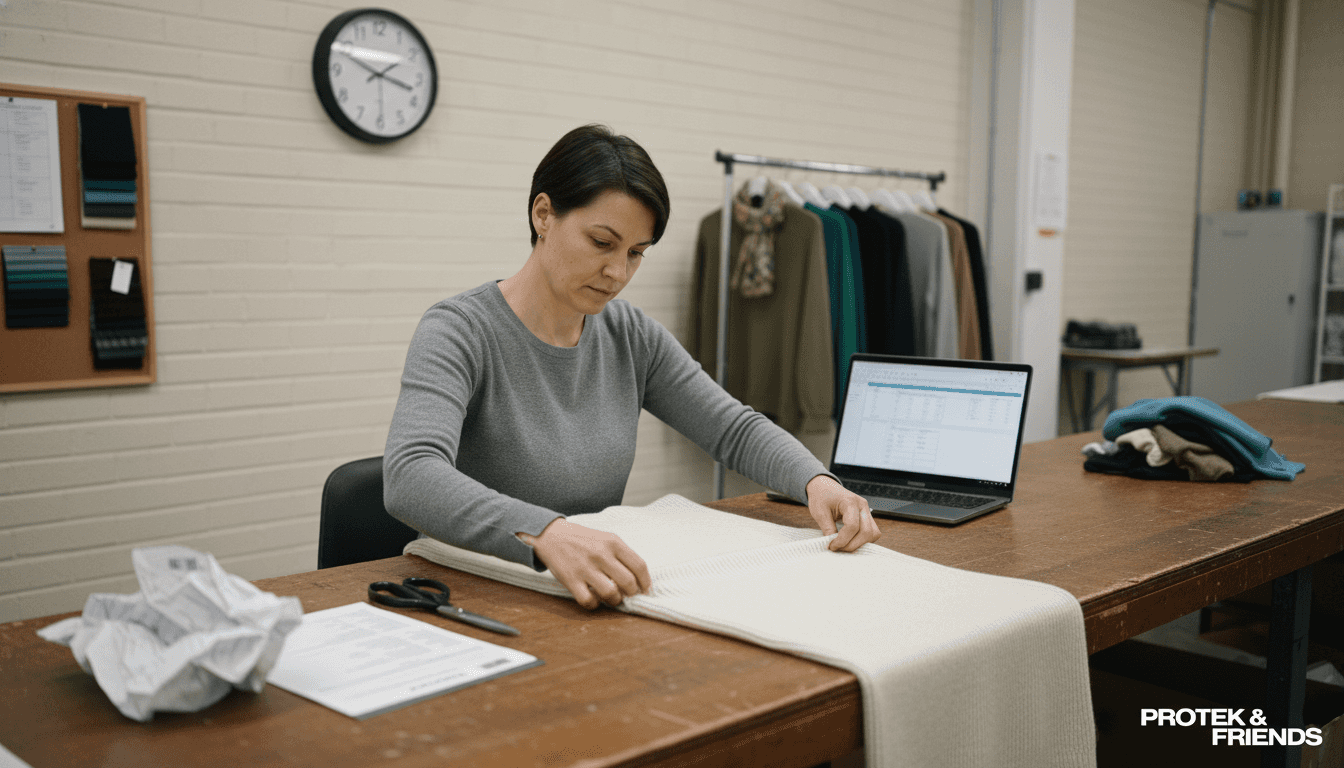
Common knitwear defects include dropped stitches that create visible holes, uneven gauge producing wavy or puckered fabric, and linking failures where seams separate or appear bulky. Catching these issues during inline monitoring costs pennies per garment. Discovering them after bulk production ships costs thousands in returns and brand damage.
Documented technical packages decrease pattern and fit errors by 40%, enabling predictable sampling cycles and fewer costly revisions. Clear documentation gives quality inspectors objective standards for evaluating each garment. Without detailed specs, quality becomes subjective and inconsistent.
Quality checkpoints should occur at these production stages:
- Yarn inspection upon arrival at the factory
- Gauge swatch approval before bulk knitting begins
- Inline monitoring during knitting to catch machine errors immediately
- Panel inspection after knitting before linking begins
- Linking quality review to verify seam strength and appearance
- Final garment inspection measuring fit, finish, and packaging
Pro Tip: Build quality checkpoints into your production timeline rather than treating them as optional add-ons. Schedule time for each inspection phase and require photographic documentation at every checkpoint. This transparency prevents surprises and builds accountability.
Proper quality control reduces defect rates from 8-12% to under 2%, protecting margins and customer satisfaction while minimizing returns and rework costs.
Implementing structured QC requires partnership with manufacturers who prioritize documentation and transparency. Factories focused purely on speed often skip inline checks, gambling that bulk production will match samples. This approach fails consistently. Reviewing a quality control checklist for knitwear helps you evaluate whether potential partners take QC seriously.
Hybrid manufacturing models: USA and overseas advantages
Hybrid manufacturing combines domestic sampling with overseas bulk production, balancing cost efficiency with quality control and speed. This model allows you to develop and approve samples quickly in the U.S., then scale production overseas where labor and material costs deliver better margins on larger runs.
Domestic sampling provides faster iteration cycles and easier communication during the critical development phase. You can review samples in person, provide immediate feedback, and approve revisions within days instead of weeks. Once your sample is perfected, overseas bulk production reduces per-unit costs significantly while maintaining quality through structured tech packs and remote monitoring.
A comparison of manufacturing models shows distinct tradeoffs:
| Model | Cost | Speed | Quality Control | Communication |
|---|---|---|---|---|
| Domestic only | Highest per-unit cost | Fastest sampling and delivery | Easiest oversight and corrections | Simplest, same time zone |
| Overseas only | Lowest per-unit cost | Slower sampling, standard bulk | Requires detailed documentation | Time zone challenges, language barriers |
| Hybrid | Moderate overall cost | Fast sampling, efficient bulk | Strong with structured processes | Clear during sampling, documented for bulk |
A U.S. knitwear brand scaled using a hybrid manufacturer with structured tech packs and quality checks, saving 15% on costs and reducing time to market by 25%. This approach works because sampling establishes quality standards domestically, then detailed documentation ensures overseas factories replicate those standards precisely.
Choosing the right model depends on your brand priorities:
- Prioritize speed and convenience: domestic only manufacturing
- Prioritize lowest possible cost: overseas only with extended lead times
- Prioritize balanced cost, quality, and scalability: hybrid model
- Prioritize control and frequent collection launches: hybrid with strong tech pack discipline
Hybrid models require rigorous documentation to succeed. Your tech pack becomes the communication bridge between domestic sampling and overseas bulk production. Without detailed specifications, quality and fit drift between locations, negating cost savings through rework and returns.
Exploring hybrid knitwear manufacturing services gives you access to established workflows that manage both domestic and overseas production seamlessly. These partnerships eliminate the coordination burden of managing separate sampling and bulk vendors.
Common misconceptions about knitwear production
Many fashion brand owners approach knitwear production with assumptions borrowed from cut-and-sew experience. These misconceptions create preventable errors, budget overruns, and quality failures. Understanding what knitwear production actually requires protects your investment and timeline.
Misconception: Knitwear is just cut-and-sew with stretchy fabric. Reality: Knitwear uses specialized knitting machines and linking techniques fundamentally different from cutting and sewing woven fabric. The production process, machinery, and quality checkpoints are distinct.
Misconception: Production errors primarily stem from poor sewing quality. Reality: Most knitwear defects originate from inadequate documentation and incomplete fit corrections during sampling. Vague tech packs create ambiguity that factories fill with guesswork.
Misconception: Overseas production always delivers the lowest cost and fastest turnaround. Reality: Hybrid models often provide better cost-quality-speed balance by combining domestic sampling efficiency with overseas bulk production economies. Pure overseas production adds weeks to sampling cycles.
These myths persist because knitwear looks similar to other apparel categories from the outside. The differences become obvious only when production begins and unexpected complications arise. Brand owners who treat knitwear like woven garments discover these distinctions through expensive mistakes.
Key myths versus facts:
- Myth: Any factory can produce knitwear. Fact: Knitwear requires circular knitting machines and trained linking technicians.
- Myth: Tech packs for knitwear are identical to cut-and-sew specs. Fact: Knitwear tech packs need gauge specifications, stitch diagrams, and linking details.
- Myth: Quality issues are rare in knitwear. Fact: Knitwear has unique defect categories like dropped stitches and gauge variations.
- Myth: Faster production always saves money. Fact: Rushing sampling creates costly bulk production errors and returns.
Recognizing these misconceptions early helps you ask better questions when evaluating manufacturers. A factory's knitwear experience, linking capabilities, and tech pack requirements reveal whether they understand knit-specific production challenges or plan to improvise.
Fabric sourcing and materials in knitwear production
Specialty yarn sourcing significantly impacts knitwear production timelines and quality outcomes. Unlike woven fabrics available from stock, many knitwear yarns require custom dyeing or specialty fiber blends with extended lead times. Planning fabric procurement early prevents production delays and rushed decisions.
Yarn selection affects every downstream production step. Fine gauge yarns create delicate, lightweight knits but increase knitting time and defect risk. Bulky yarns knit faster but limit design complexity and drape. Your yarn choice determines machine compatibility, linking techniques, and finishing requirements.
Fabric testing validates yarn performance before bulk production begins. Required tests include gauge consistency, weight verification, stretch and recovery measurement, and shrinkage evaluation. These tests prevent surprises during bulk knitting when changing yarn becomes prohibitively expensive. Skipping fabric testing gambles your entire production run on untested materials.
Yarn availability and testing delays extend overall production schedules by two to six weeks depending on fiber type and supplier location. Custom-dyed yarns require minimum order quantities that may exceed your initial production needs, creating inventory management challenges.
Best practices for fabric planning include:
- Source and approve yarns before finalizing tech packs to ensure availability
- Build two to four weeks of buffer time for yarn procurement and testing
- Order test yardage separately to validate performance before bulk orders
- Document approved yarn specifications including supplier, lot numbers, and test results
- Establish backup yarn sources for critical materials to prevent single-supplier dependency
Clear documentation prevents sourcing miscommunication. Your tech pack should specify exact yarn composition, weight, color references, and acceptable tolerance ranges. Vague descriptions like "soft cotton blend" leave room for substitutions that alter garment appearance and performance.
Coordination with suppliers requires proactive communication. Manufacturers with established fabric sourcing for knitwear networks streamline procurement and reduce lead times through existing vendor relationships. These partnerships provide access to tested yarn sources and faster sampling turnaround.
Fit correction and sampling
Fit correction during sampling prevents the majority of knitwear quality failures. About 60% of knitwear defects trace back to inaccurate fit adjustments made during the sampling phase. Rushing this process or accepting "close enough" samples guarantees problems during bulk production.
Knit fabrics behave differently than woven materials, stretching and recovering in ways that affect fit and drape. Your first sample reveals how the fabric performs on the body, where adjustments are needed, and whether the pattern achieves your design intent. Expecting perfection on the first try sets unrealistic expectations.
The iterative sampling cycle follows this sequence:
- Initial sample creation based on your tech pack specifications
- Fit review evaluating measurements, drape, and overall appearance
- Tech pack updates documenting precise adjustments needed
- Second sample incorporating revisions for final validation
- Final approval and documentation establishing bulk production standards
Each iteration refines the pattern and clarifies expectations. Detailed feedback with measurements and photographic documentation ensures your manufacturer understands exactly what needs adjustment. Vague comments like "make it fit better" produce random changes that may worsen problems.
Structured fit correction reduces bulk order defects and customer returns significantly. When your approved sample matches your quality standards precisely, bulk production simply replicates that standard across all units. Without rigorous sampling, every bulk garment becomes an experiment.
Pro Tip: Budget time for at least two full sampling rounds in your production schedule. Three rounds are common for complex designs or new manufacturer relationships. Rushing sampling to hit launch dates backfires when bulk production arrives with fit issues requiring expensive corrections or complete reruns.
Photo documentation improves remote communication with manufacturers. Annotate photos showing specific fit issues, measurement discrepancies, and desired adjustments. Visual references prevent misinterpretation and create shared understanding of quality standards.
Communication and transparency between brands and factories
Communication failures cause more production delays than technical errors. Vague updates, delayed problem reporting, and insufficient documentation create uncertainty that spirals into missed deadlines and budget overruns. Better communication increases on-time deliveries by 20%.
Common breakdowns include factories that avoid reporting problems until they become crises, brand owners who provide incomplete specifications then blame manufacturers for confusion, and both parties making assumptions instead of asking clarifying questions. These patterns repeat across the industry because structured communication feels like extra work until its absence creates disasters.
Best practices for production communication:
- Schedule regular update calls or emails at predetermined milestones
- Share comprehensive tech packs before requesting quotes or samples
- Escalate potential issues immediately when discovered, not when deadlines loom
- Document all decisions, changes, and approvals in writing with timestamps
- Establish clear points of contact for technical, scheduling, and payment questions
- Use visual references and annotated photos to clarify specifications
- Confirm understanding by having manufacturers summarize their interpretation
Transparency builds trust and enables proactive problem solving. Manufacturers who report potential yarn delays three weeks in advance give you time to adjust launch plans or source alternatives. Factories that hide problems until shipping deadlines pass leave you with no options except accepting late delivery or scrambling for replacement inventory.
Your role in communication matters as much as your manufacturer's responsiveness. Providing complete information upfront, responding promptly to questions, and maintaining realistic expectations creates partnership dynamics rather than adversarial relationships. Production works best when both parties prioritize shared success.
Structured workflows formalize communication expectations. Transparent knitwear production communication protocols establish when updates occur, what information gets shared, and how problems get escalated. This structure removes ambiguity and creates accountability.
Case studies in knitwear production
Real examples demonstrate how structured knitwear production processes deliver measurable results. A U.S. knitwear brand scaled from concept to bulk with a hybrid manufacturer using detailed tech packs and quality checkpoints, achieving 15% cost savings and 25% faster time to market compared to their previous purely domestic production.
This success came from implementing systems rather than hoping for good outcomes. The brand invested time developing comprehensive tech packs with gauge specifications, stitch diagrams, and measurement charts for every size. They scheduled quality checkpoints at fabric inspection, inline knitting, and final garment stages. Communication protocols established weekly updates and immediate escalation for any deviations from approved samples.
Benefits realized through structured production:
- Reduced sampling errors by documenting precise specifications before requesting samples
- Eliminated pattern confusion by providing detailed tech packs with visual references
- Caught quality issues during inline monitoring before they affected entire production runs
- Maintained consistent communication through scheduled updates and clear escalation paths
- Scaled efficiently from small test runs to larger production volumes with predictable outcomes
Hybrid manufacturing enabled this growth trajectory. Domestic sampling provided fast iteration during development, while overseas bulk production delivered margin-friendly pricing on larger orders. The structured approach ensured quality remained consistent across both locations.
Other brands demonstrate similar patterns. Companies that treat production as a structured process with documented standards consistently outperform those relying on informal relationships and verbal agreements. Systems beat chaos every time.
Exploring hybrid knitwear production case studies reveals common success factors across different brand categories and production scales. Documentation, communication, and quality checkpoints appear in every successful partnership.
Industry examples from established knitwear brand examples show how professional production systems support sustainable growth. These brands maintain consistent quality across seasons because their manufacturing processes prioritize structure over improvisation.
Summary and practical steps for brand owners
Knitwear production requires specialized machinery, unique processes, and structured workflows distinct from cut-and-sew apparel manufacturing. Understanding these differences protects your investment and enables scalable growth. Documentation reduces errors, quality checkpoints catch defects early, and transparent communication prevents costly surprises.
Evaluating potential knitwear manufacturers requires examining specific capabilities and practices:
- Knitwear-specific experience with circular knitting machines and linking equipment
- Tech pack requirements demonstrating attention to detail and specification rigor
- Quality control practices including inline monitoring and checkpoint documentation
- Communication protocols establishing update frequency and problem escalation procedures
- Hybrid manufacturing capabilities if you want domestic sampling with overseas bulk production
- References from brands with similar production volumes and quality standards
- Transparent pricing that itemizes costs rather than providing opaque total quotes
Investing time in documentation and communication upfront reduces total production costs and timelines. Comprehensive tech packs cost hours to create but prevent weeks of sampling delays. Regular communication requires discipline but catches problems while solutions remain inexpensive.
Structured production partnerships enable you to scale predictably from initial samples through larger production runs. Systems create consistency that protects your brand reputation and customer satisfaction. Every successful knitwear brand eventually adopts these practices because improvisation fails at scale.
Prioritize manufacturers who value quality and transparency over those promising the lowest prices or fastest timelines. Production is an investment in your brand's future, not a commodity to source purely on cost. Partners aligned with your quality standards become strategic assets as you grow.
Partner with Protek & Friends for structured knitwear production
Applying these knitwear production principles requires partnering with manufacturers who prioritize systems over improvisation. Protek & Friends specializes in hybrid knitwear production combining U.S. sampling efficiency with overseas bulk production economics. Our structured workflows include detailed tech pack development, quality checkpoints at every production stage, and transparent communication that eliminates surprises.
We built our process around the documentation and quality control practices this guide recommends because they work.
Explore our clothing production services in Los Angeles to see how structured knitwear production protects your margins and accelerates growth. Compare Protek to other manufacturers and discover why brand owners who value transparency choose partners with proven systems. Good production should feel predictable, not stressful.
FAQ
What is the main difference between knitwear production and cut-and-sew garment manufacturing?
Knitwear production uses knitting machines to construct fabric directly from yarn, creating garments through interlocked loops rather than cutting pre-woven material. This process requires specialized linking techniques to join knit panels with seams that maintain stretch and durability. Cut-and-sew manufacturing starts with woven fabric sheets cut into pattern pieces then sewn together using standard industrial sewing machines.
How do tech packs improve knitwear production quality?
Tech packs provide detailed specifications for stitch patterns, gauge measurements, yarn composition, and linking requirements that eliminate ambiguity during production. Documented technical packages decrease pattern and fit errors by 40% by giving manufacturers objective standards for sampling and quality evaluation. This documentation enables smoother sampling cycles and reduces costly revision rounds that delay production timelines.
Why consider a hybrid manufacturing model for knitwear production?
Hybrid manufacturing combines fast U.S. sampling with cost-efficient overseas bulk production, balancing quality control with margin protection. Hybrid production achieves 15% cost savings and 25% faster time to market compared to purely domestic manufacturing. This model allows you to perfect samples quickly through in-person reviews, then scale production overseas while maintaining quality through detailed tech pack documentation.
What causes most quality failures in knitwear, and how can they be prevented?
Approximately 60% of knitwear quality failures stem from inaccurate fit corrections during sampling stages rather than bulk production errors. Structured iterative sampling with detailed feedback protocols prevents these defects by refining patterns and specifications before bulk orders begin. Investing time in multiple sampling rounds with photographic documentation and precise measurement adjustments eliminates the majority of quality issues that create returns and customer dissatisfaction.