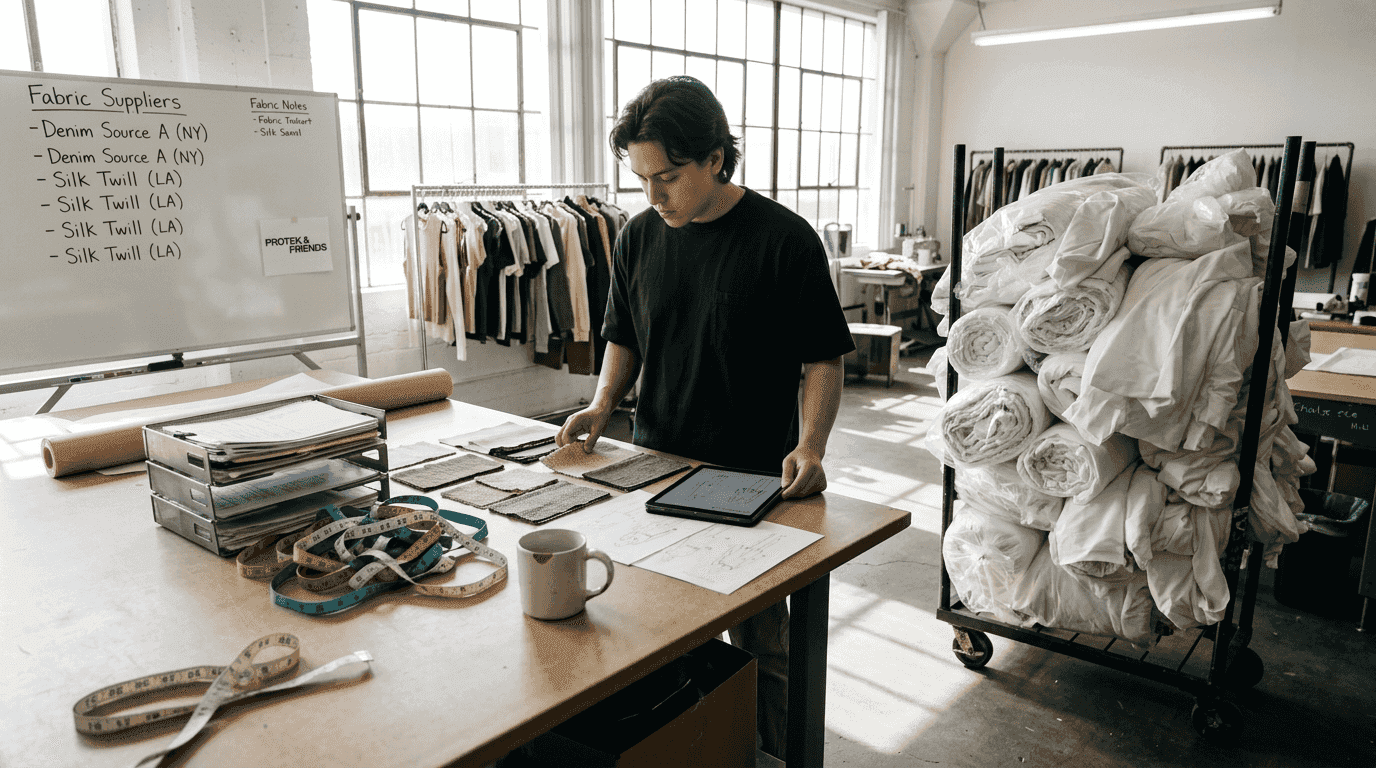
Many start-up fashion brands lose thousands of dollars to quality defects and production delays because they skip critical quality control steps and choose factories based on price alone. Without structured workflows, inline inspections, and clear documentation, even the best designs fail in bulk production. This guide covers essential processes including AQL sampling, inline QC, final inspection, and factory selection criteria that help you scale your clothing line effectively in 2026. Understanding these production fundamentals prevents costly mistakes, protects your margins, and builds the foundation for reliable delivery and sustainable brand growth.
Table of Contents
- Understanding clothing factory workflows and their impact on start-ups
- Building a robust apparel quality control system for consistent clothing production
- Essential documentation and specifications to secure accurate factory quotes and production outcomes
- Balancing quality and cost: sewing standards and common apparel defects to watch for
- Scale your clothing line with Protek & Friends' full-package production services
- Frequently asked questions
Key takeaways
| Point | Details |
|---|---|
| Multi-layered QC systems | Quality control requires AQL sampling, inline inspections, and final checks to catch defects early and maintain consistency. |
| Factory workflow selection | Choosing the right production workflow prevents supply chain failures and protects your margins from unexpected costs. |
| Production-ready documentation | Clear tech packs and specifications reduce disputes with factories and improve quality outcomes across all production runs. |
| Optimal stitch density | Setting stitch density between 12–14 SPI balances durability with cost effectiveness in apparel manufacturing. |
| Structured processes enable scaling | Implementing systematic QC and workflow controls supports reliable production growth for emerging fashion brands. |
Understanding clothing factory workflows and their impact on start-ups
Apparel production workflows define how your garments move from raw materials to finished products. These workflows determine everything from lead times and minimum order quantities to quality consistency and communication clarity. For start-ups scaling beyond their first collection, selecting the wrong production workflow causes more supply chain failures than poor design ever could.
The most common workflows include cut, make, and trim (CMT) where you source all materials, full-package manufacturing where the factory handles sourcing, and hybrid models that split responsibilities. Each approach carries distinct implications for your cash flow, quality control access, and production flexibility. CMT gives you material control but requires deep supplier relationships and inventory management. Full-package simplifies logistics but reduces your visibility into component quality.
Your workflow choice must align with your current scale and product complexity. A 500-piece knitwear collection has different needs than a 2,000-piece denim run with custom washes. Consider these factors when evaluating factory workflows:
- Production capacity and minimum order requirements that match your volume
- Flexibility to accommodate design revisions and fit corrections
- Communication systems that provide regular updates without constant chasing
- Quality control access at multiple production stages
- Lead time reliability and penalty clauses for delays
Pro Tip: Request a factory's production calendar and client list before committing. Factories juggling too many brands simultaneously cannot give your order the attention needed for quality outcomes.
Poor workflow selection creates cascading problems throughout production. Factories optimized for high-volume basics struggle with specialty finishes and detailed construction. Manufacturers focused on fast fashion timelines cannot accommodate the sampling iterations that emerging brands need for fit perfection. When workflows mismatch your requirements, you face delayed deliveries, quality compromises, and margin erosion from rushed air freight to meet launch dates. Understanding managing clothing production workflows prevents these costly mistakes and establishes the foundation for a structured apparel workflow that protects your business.
Building a robust apparel quality control system for consistent clothing production
Quality control cannot happen only at the end of production. Implementing a robust Apparel Quality Control system with AQL, inline QC, and final inspection significantly reduces returns and ensures the bulk order matches your approved samples. Each QC layer serves a specific purpose in catching defects before they multiply across thousands of units.
Acceptance Quality Limit (AQL) establishes the maximum number of defects allowed in a production batch before rejection. AQL categorizes defects into three levels: minor issues like loose threads that do not affect function, major defects like incorrect measurements that impact wearability, and critical flaws like broken zippers that make garments unsellable. Standard AQL levels for apparel range from 1.5 for critical defects to 4.0 for minor issues, meaning inspectors will reject batches exceeding these thresholds.
Inline quality control happens during production at strategic checkpoints. Inspectors verify fabric alignment after cutting, check stitch quality during assembly, and confirm measurements before finishing. This approach catches problems early when corrections cost less and waste fewer materials. Inline QC typically occurs at 20%, 50%, and 80% production completion, giving factories time to adjust processes before defects spread.
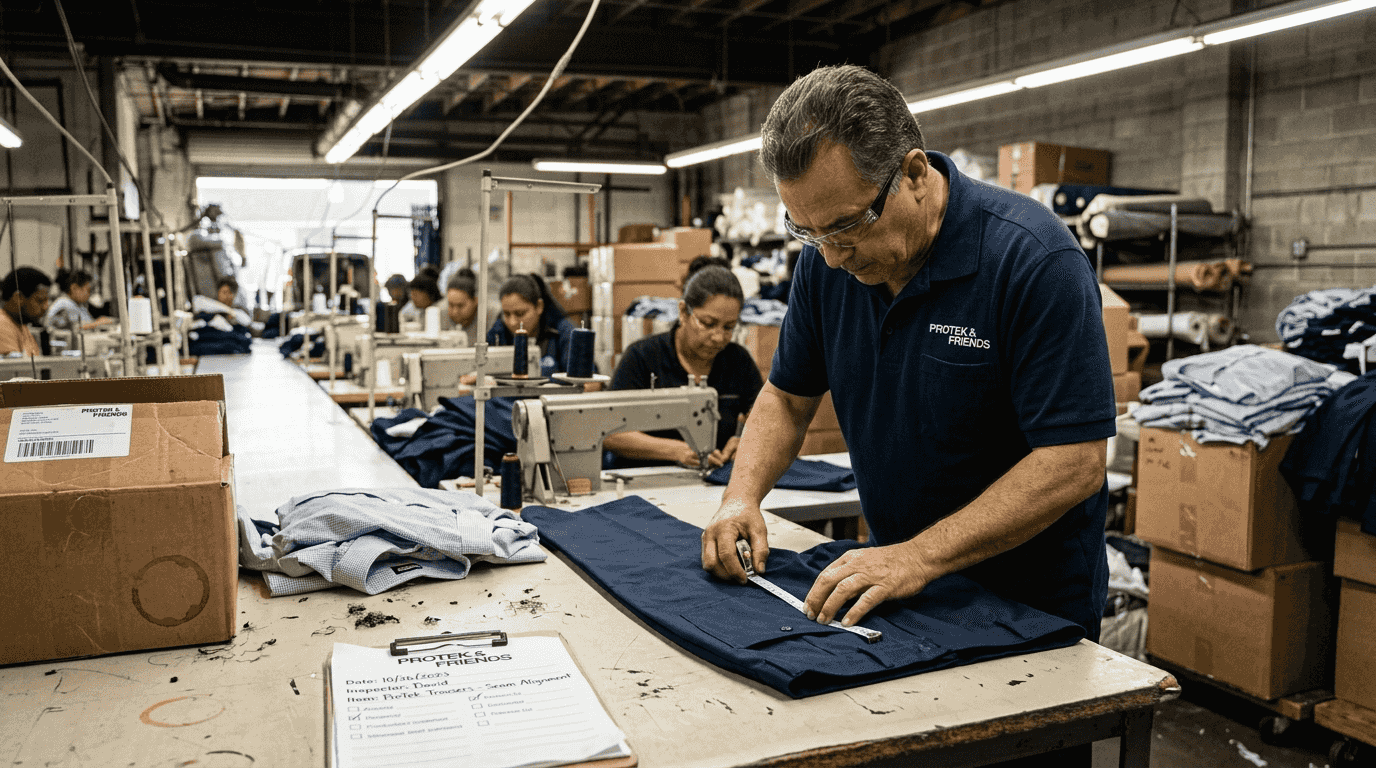
Final inspection occurs after production completes but before shipping. Inspectors verify packaging integrity, label accuracy, print placement and quality, garment measurements against tech pack specifications, and size distribution matching your purchase order. This comprehensive check ensures your order meets all specifications before leaving the factory floor.
Here is how the three QC layers compare:
| QC Layer | Purpose | Timing | Key Checks |
|---|---|---|---|
| AQL Sampling | Set defect tolerance limits | Before production starts | Defect categorization and acceptance thresholds |
| Inline QC | Catch issues during production | At 20%, 50%, 80% completion | Stitching quality, measurements, fabric alignment |
| Final Inspection | Verify complete order accuracy | After production, before shipping | Packaging, labels, prints, size distribution |
Implement these QC processes in your garment production:
- Establish AQL standards in your purchase order and factory contract
- Schedule inline inspections at agreed production milestones
- Require photographic documentation at each QC checkpoint
- Define clear processes for handling failed inspections and rework
- Conduct or hire third-party final inspection before approving shipment
- Document all QC results for future production reference
Pro Tip: Relying solely on final inspection is expensive and risky. Discovering major defects after production completes leaves you choosing between accepting substandard goods or paying for complete rework that delays your launch. Inline QC costs less and saves time by preventing defects rather than finding them too late.
Understanding these fashion quality control fundamentals transforms how you work with factories and protects your brand reputation from quality failures that damage customer trust.
Essential documentation and specifications to secure accurate factory quotes and production outcomes
Incomplete specifications cause most manufacturing disputes and quality failures. Gathering Timeline Strategy, Decision Roles, Design Assets, Tech Pack and BOM, Financials, and Product Definition creates production-ready standards that eliminate ambiguity and align factory expectations with your requirements.
Your tech pack serves as the single source of truth for production. It must include detailed technical drawings showing front, back, and side views, precise measurements for every size in your range, construction details specifying seam types and stitch counts, fabric specifications including content, weight, and finish, and trim details covering buttons, zippers, labels, and packaging. Missing any of these elements invites factories to make assumptions that rarely match your vision.
The bill of materials (BOM) lists every component needed to produce one garment with exact quantities, supplier information, and approved color codes. Your BOM should specify primary fabric yardage per size, lining and interlining requirements, all trims with supplier part numbers, thread colors matched to Pantone codes, and packaging materials including hangtags, poly bags, and boxes. Detailed BOMs prevent factories from substituting cheaper alternatives that compromise quality.
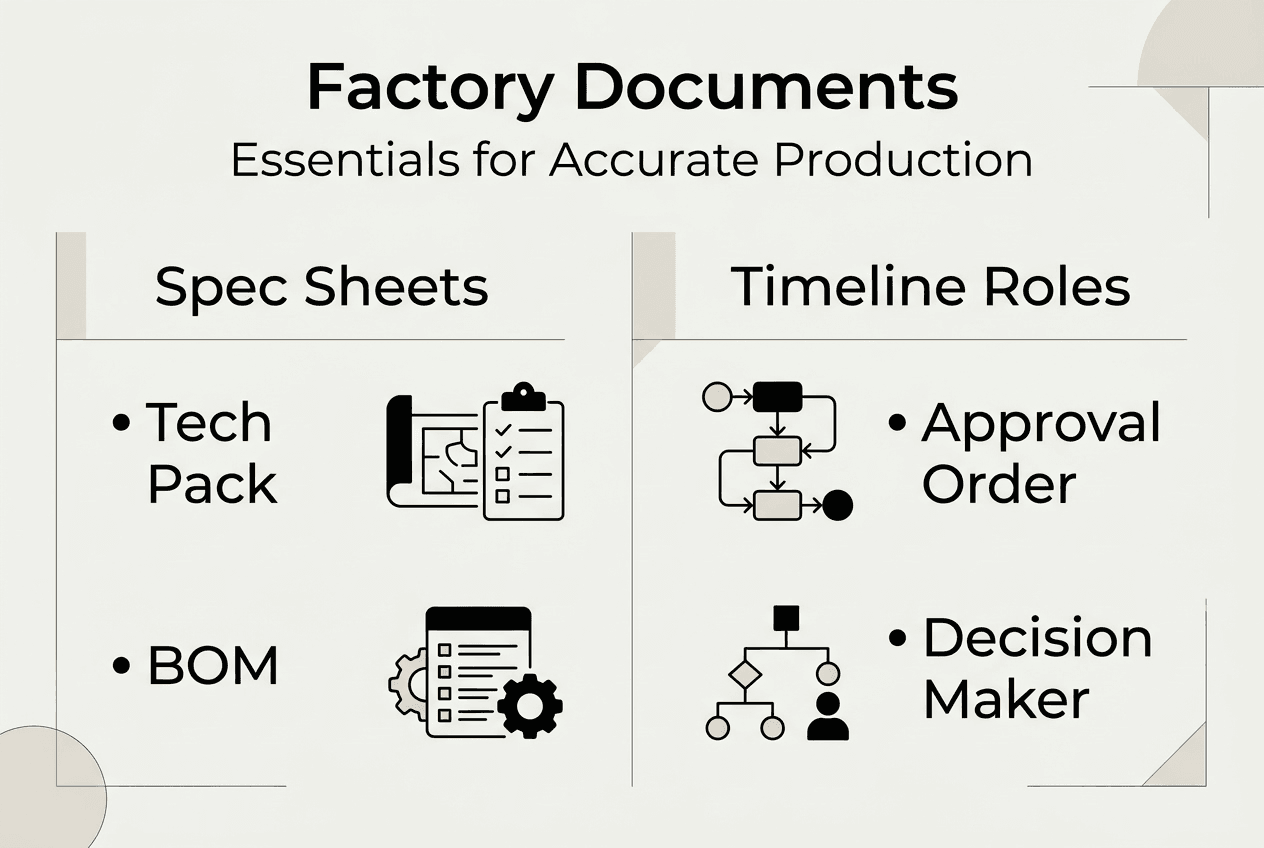
Timeline strategy and decision roles clarify who approves what and when. Define approval authority for fabric selections, fit corrections, color matching, and production go-ahead. Establish response time expectations for both sides so production does not stall waiting for answers. Map critical path milestones including sampling deadlines, bulk fabric ordering, production start, and delivery dates with buffer time for unexpected delays.
Product definition goes beyond basic descriptions to specify performance requirements. Detail wash and care instructions, colorfastness standards, shrinkage tolerances, and durability expectations. For specialty items, include construction techniques like flat-felled seams for denim or linking for knitwear that impact both quality and cost.
Avoid these common specification pitfalls:
- Using unclear size labels like small, medium, large without actual measurements
- Omitting fabric weight and stretch percentage for knits
- Providing low-resolution design files that factories cannot read accurately
- Skipping stitch type specifications and leaving construction methods to factory interpretation
- Forgetting to specify packaging requirements and labeling compliance for your market
- Neglecting to include approved sample reference with your purchase order
Prepare samples and measurements according to industry standards before requesting bulk quotes. Send physical samples when possible so factories can assess construction complexity accurately. Reference samples eliminate confusion about finishes, hand feel, and quality expectations that written descriptions cannot fully capture. Proper clothing sample development sets the quality benchmark for your entire production run and reduces costly misunderstandings.
Balancing quality and cost: sewing standards and common apparel defects to watch for
Stitch density measured in stitches per inch (SPI) directly impacts garment durability and production cost. Setting stitch density to 12–14 SPI provides durability while controlling costs, as higher density increases quality but slows production and lower density cuts expenses but compromises structural integrity. Understanding this balance helps you specify appropriate standards for different garment types and price points.
Low stitch density below 10 SPI creates weak seams prone to splitting under normal wear stress. Seams pull apart easily, hems unravel quickly, and garments fail quality expectations that customers have for any price point. Extremely high density above 16 SPI increases thread costs, slows sewing speed, and can cause fabric puckering without meaningful durability gains for most apparel applications.
Here is how stitch density affects production outcomes:
| Stitch Density | Durability | Production Cost | Appearance | Best Use |
|---|---|---|---|---|
| Below 10 SPI | Poor, seams split easily | Lowest | Loose, unprofessional | Avoid for all apparel |
| 12–14 SPI | Excellent for most apparel | Moderate | Clean, professional | Standard clothing production |
| Above 16 SPI | Marginal improvement | Highest | Risk of puckering | Specialty items only |
Common apparel defects you should reject immediately include seam puckering caused by incorrect tension or feed issues, fabric flaws like holes, slubs, or color inconsistencies, misaligned patterns at seams especially for stripes and plaids, skipped stitches creating weak points in seam integrity, and incorrect measurements exceeding your specified tolerance range. Each defect category requires different prevention strategies during production.
Seam puckering happens when machine tension settings mismatch fabric weight or when differential feed mechanisms fail to coordinate fabric layers properly. Lightweight fabrics pucker easily under high tension while heavy materials need stronger tension for secure seams. Factories must calibrate machines specifically for your fabric before bulk production starts.
Pro Tip: Before approving bulk production, inspect sewing quality on your pre-production samples under good lighting. Check seam puckering by stretching seams gently, verify stitch density with a measuring tool, and examine thread tension consistency across the entire garment. Catching sewing issues at the sample stage prevents thousands of defective units.
Fabric defects originate from textile mills but become your problem if not caught early. Require factories to inspect all fabric upon receipt and document any flaws before cutting begins. Establish clear policies about acceptable flaw frequency and size so factories know when to reject fabric shipments rather than cutting around defects.
Communicate stitching standards clearly in your tech pack with specific SPI requirements for different seam types. Specify higher density for stress points like armholes and crotch seams while allowing standard density for less critical areas like hem finishes. This targeted approach optimizes quality where it matters most without inflating costs unnecessarily. Proper scaling quality control in apparel production requires understanding these technical details and holding factories accountable to documented standards.
Scale your clothing line with Protek & Friends' full-package production services
Navigating factory workflows, quality control systems, and production documentation feels overwhelming when you are focused on design and brand building. You need a manufacturing partner who implements these best practices as standard operating procedure, not as special requests that complicate communication.
Protek & Friends specializes in full-package clothing manufacturing for start-ups ready to scale with professional systems. Our hybrid USA and overseas production model gives you flexibility without sacrificing quality control or communication clarity. We handle tech pack review, fabric sourcing, sampling iterations, and multi-stage quality inspections so you can focus on growing your brand. Our clothing production services eliminate the anxiety of placing new purchase orders by replacing factory chaos with structured processes, clear documentation, and predictable timelines. Explore how Protek & Friends can support your production needs in 2026 with systems built for brands who value structure over stress.
Frequently asked questions
What is AQL and why is it important for start-up clothing factories?
AQL defines the maximum number of defects allowed in a production batch before rejection, protecting you from receiving substandard goods. It categorizes defects as minor, major, or critical to align quality expectations between your brand and the factory. Without AQL standards in your purchase order, you have no objective basis for rejecting poor quality shipments.
How does inline quality control differ from final inspection?
Inline QC occurs at multiple production stages to catch and correct issues while manufacturing is still in progress. Final inspection happens after production completes to verify all specifications, packaging, and labeling are correct before shipment. Inline QC prevents defects while final inspection confirms overall order accuracy.
What key information should I include in a tech pack for accurate factory quotes?
Include design assets with technical drawings, fabric specifications with weight and content, precise measurements for all sizes, detailed stitching instructions with SPI requirements, and a complete bill of materials listing every component. Clear timeline expectations and decision-making authority help align factory processes with your brand requirements. Missing any element invites factories to make assumptions that increase costs or compromise quality.
Why is stitch density important and what is the recommended range?
Stitch density directly affects seam strength and garment durability under normal wear conditions. Higher density improves quality but increases production time and thread costs. The 12–14 SPI range offers optimal balance between structural integrity and manufacturing efficiency for most apparel categories without causing fabric puckering or excessive expense.