Many founders assume the cheapest route to production leads to profitability. But in reality, poor documentation and fragmented manufacturing often cost more through errors and delays. The real question is not which factory quotes the lowest price per unit, but which partner delivers predictable outcomes with clear systems. This guide unpacks the reality of full package production (FPP) and how it empowers brand scaling. We will cover what FPP actually includes, how the process works step by step, cost breakdowns versus traditional cut-make-trim (CMT) models, key considerations for U.S. fashion brands, and a practical evaluation checklist. By the end, you will know how to confidently choose a manufacturing partner who protects your margins and supports your growth.
Table of Contents
- What is a full package clothing manufacturer?
- Step-by-step: The FPP clothing production process
- FPP vs. CMT: Cost, risk, and workflow comparison
- Key considerations for U.S. fashion brands
- How to evaluate and select the right FPP manufacturer
- Looking for a trusted FPP partner?
- Frequently asked questions
Key Takeaways
| Point | Details |
|---|---|
| End-to-end control | Full package manufacturers handle every stage for you and offer approvals at key milestones. |
| Hidden cost benefits | Despite higher unit prices, FPP often saves on errors, delays, and logistical headaches. |
| US brand priorities | Domestic FPP solutions often prioritize quality, speed, and compliance, which can outweigh pure cost savings. |
| Choose with confidence | Use a clear checklist focusing on transparency, QC, and documentation before choosing your partner. |
What is a full package clothing manufacturer?
Now that we have set the stage for why foundational choices matter, let us clarify what full package manufacturing really means. A full package clothing manufacturer handles every step of production from concept to finished goods. This includes sourcing fabrics and trims, pattern making, grading, sampling, bulk production, quality control, and shipping. You provide the design vision and tech pack. The manufacturer executes the rest.
This contrasts sharply with CMT (Cut, Make, Trim) models, where you must source all materials yourself and manage much more of the process. In CMT, the factory only cuts fabric, sews garments, and attaches trims. You coordinate suppliers, handle logistics, and troubleshoot quality issues across multiple vendors. FPP consolidates that complexity into one accountable partner.
The typical FPP process includes these stages:
- Brand brief and tech pack submission
- Material sourcing (fabrics, trims, labels)
- Pattern making and grading
- Sampling cycles (prototype, fit, pre-production)
- Bulk production
- Quality control inspections
- Packing and shipping
Brands approve work at key stages for quality and control. This ensures you stay involved where it matters most, without managing every vendor relationship or logistics detail.
"Full package manufacturing is not about handing over control. It is about replacing chaos with systems so you can focus on design, marketing, and growth."
When you work with an FPP partner, you are bringing fashion concepts to life through a structured, documented process. The manufacturer takes responsibility for execution. You maintain approval authority at critical milestones.
Step-by-step: The FPP clothing production process
Understanding what FPP includes, let us walk through what actually happens with your brand in an FPP partnership. Each stage has clear deliverables, required approvals, and documentation to keep the process transparent.
-
Tech pack creation and review: You submit a detailed tech pack with sketches, measurements, construction notes, and material specifications. The manufacturer reviews it for feasibility, flags potential issues, and confirms they can execute your vision.
-
Material sourcing: The manufacturer sources fabrics, trims, labels, and packaging based on your specifications. They provide swatches and samples for your approval before purchasing bulk quantities. This stage prevents costly mistakes from incorrect materials.
-
Pattern making and grading: A pattern maker creates the first pattern from your tech pack. The pattern is graded across your size range. You receive pattern files for review if needed.
-
Sampling cycles: This is where your design becomes real. The sampling process typically includes three rounds. Prototype samples test the design and construction. Fit samples verify sizing and proportions on fit models. Pre-production samples confirm final materials, colors, and construction before bulk orders.
-
Bulk manufacturing: Once you approve the pre-production sample, the factory begins bulk production. They follow the approved sample exactly, using documented specifications to maintain consistency across all units.
-
Quality control: Inspections happen during and after production. QC teams check measurements, stitching, fabric quality, and finishing. Defective units are identified and corrected before shipping.
-
Packing and shipping: Finished garments are packed according to your requirements (hangers, poly bags, boxes) and shipped to your warehouse or fulfillment center.
Pro Tip: A well-prepared tech pack is your insurance policy. The more detailed your specifications, the fewer surprises you will encounter during sampling and production. Include close-up photos of construction details, stitch types, and finishing expectations.
Here is a breakdown of typical timelines and approval points:
| Stage | Duration | Brand Approval Required |
|---|---|---|
| Tech pack review | 3-5 days | Yes |
| Material sourcing | 2-4 weeks | Yes (swatches) |
| Pattern making | 1-2 weeks | Optional |
| Prototype sample | 2-3 weeks | Yes |
| Fit sample | 2-3 weeks | Yes |
| Pre-production sample | 2-3 weeks | Yes |
| Bulk production | 4-8 weeks | No (but progress updates) |
| QC and packing | 1-2 weeks | Optional (inspection reports) |
| Shipping | 1-4 weeks | No |
Understanding types of garment sampling helps you know what to expect at each approval stage. Each sample serves a specific purpose. Skipping stages to save time often leads to expensive corrections later.
FPP vs. CMT: Cost, risk, and workflow comparison
Once the FPP process is clear, it is critical to see how this stacks up against the traditional CMT approach. The choice between FPP and CMT is not just about unit cost. It is about total ownership costs, risk distribution, and how much operational complexity you want to manage.
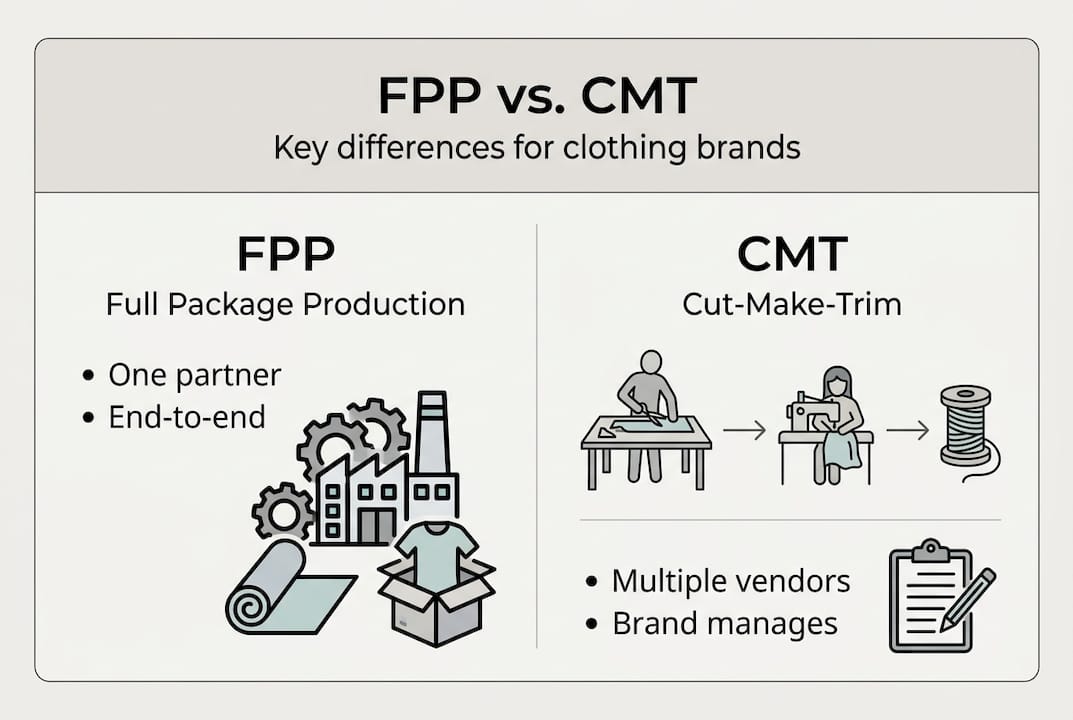
FPP costs 15-35% more per unit than CMT due to sourcing margins, but it lowers total ownership costs by reducing logistics, capital tie-up, and errors. CMT may deliver lower quotes, but brands pay through logistics delays, sourcing errors, and quality inconsistency.
Here is a side-by-side comparison:
| Factor | Full Package Production (FPP) | Cut-Make-Trim (CMT) |
|---|---|---|
| Unit cost | Higher (15-35% premium) | Lower (labor only) |
| Material sourcing | Manufacturer handles | Brand handles |
| Quality control | Manufacturer responsible | Brand responsible |
| Logistics coordination | Single point of contact | Multiple vendors |
| Lead time predictability | Higher (integrated process) | Lower (coordination delays) |
| Error cost | Lower (fewer handoffs) | Higher (sourcing mistakes) |
| Capital requirements | Lower (no material inventory) | Higher (pre-purchase materials) |
| Compliance management | Manufacturer handles | Brand handles |
Pro Tip: To calculate total ownership costs, add up unit price, rework expenses, delayed launch costs, and the value of your time spent coordinating vendors. FPP often wins when you factor in the full picture.
For U.S. brands, domestic FPP prioritizes speed and quality over pure cost. If you are launching seasonal collections or testing new designs, the faster turnaround and reduced risk of FPP can protect your margins better than a lower CMT quote.
The hidden costs of CMT include:
- Sourcing errors (wrong fabric weight, color mismatch, insufficient yardage)
- Logistics delays between multiple vendors
- Quality issues discovered after production
- Time spent managing vendor relationships
- Capital tied up in material inventory
FPP consolidates these risks into one accountable partner. When something goes wrong, you have one conversation, not five. When timelines shift, you get early warning and solutions, not excuses.
Understanding production terms explained helps you ask the right questions when comparing quotes. Do not just compare unit prices. Compare total project costs, risk allocation, and timeline predictability.
Key considerations for U.S. fashion brands
Beyond process and cost, there are key factors that U.S. brands in particular should weigh when evaluating FPP partners. Your location, target market, and growth goals shape which manufacturing model serves you best.
Domestic FPP reduces lead times and communication gaps. Working with a Los Angeles-based manufacturer means you can visit the facility, review samples in person, and resolve issues in real time. Time zone alignment and cultural familiarity streamline communication. You avoid the 12-week ocean freight delays that come with overseas production.
U.S. compliance is easier with FPP. Labeling requirements, labor standards, and import regulations are complex. An experienced FPP partner handles these details. They ensure your garments meet Federal Trade Commission labeling rules, include proper care instructions, and comply with country-of-origin requirements. You avoid costly recalls or customs delays.
Scaling with documented processes minimizes risk. As your order sizes grow, inconsistency becomes expensive. A quality control guide shows how documented QC checkpoints protect your brand reputation. FPP manufacturers use standardized processes that scale reliably. Your 500-unit order gets the same attention as your 5,000-unit order.
"Good production should feel boring. Clear updates. Early problem solving. Zero surprises."
When evaluating FPP partners, ask these questions:
- What quality control checkpoints do you use during production?
- How many sampling rounds are included in your process?
- How do you track production progress and communicate updates?
- What documentation do you provide at each stage?
- How do you handle corrections if samples do not meet specifications?
- What is your policy on minimum order quantities?
- Can you provide references from brands similar to mine?
The answers reveal whether a manufacturer operates with systems or just takes orders. You want a partner who can scale with quality, not just volume.
For U.S. brands launching their second or third collection, FPP offers a clear advantage. You have already learned the basics of production. Now you need a partner who can execute consistently while you focus on design, marketing, and customer acquisition.
How to evaluate and select the right FPP manufacturer
Knowing what to look for, here is how to vet and confidently choose the right FPP partner for your business goals. This checklist helps you separate professional manufacturers from factories that overpromise and underdeliver.
Must-have capabilities:
-
Documented process: The manufacturer should provide a clear timeline with milestones, deliverables, and approval points. Typical FPP process includes documented approvals for each stage (brand brief, sourcing, grading, sampling, production, QC, shipping).
-
Tech pack review: Before quoting, they should review your tech pack for feasibility and flag potential issues. This shows they understand construction and can execute your design.
-
Real sampling: Confirm they include multiple sampling rounds (prototype, fit, pre-production). Manufacturers who skip sampling to save time create expensive problems later.
-
QC transparency: Ask to see sample QC reports. Professional manufacturers document inspections with photos, measurements, and defect rates.
-
Communication style: Pay attention to response times and clarity. If communication is unclear during the quoting process, it will not improve during production.
Warning signs to avoid:
- Vague timelines or reluctance to commit to deadlines
- No documented process or written agreements
- Pressure to skip sampling stages
- Unclear pricing or hidden fees
- Limited references or portfolio
- Poor communication or slow responses
Recommended steps for your first order:
- Start with a small production run if possible (100-300 units)
- Request sample QC reports from previous projects
- Require multi-stage approvals (prototype, fit, pre-production)
- Visit the facility if it is domestic
- Ask for a detailed cost breakdown (materials, labor, overhead)
- Confirm their experience with your garment category (denim, knitwear, cut and sew)
- Review their terms for corrections and defects
Building strong manufacturing relationships takes time. Your first order is a test. Pay attention to how the manufacturer handles problems, communicates delays, and delivers on promises. A good partner will be transparent about challenges and proactive with solutions.
Pro Tip: Ask to speak with two or three current clients. Ask them about communication, quality consistency, and how the manufacturer handles corrections. Their answers will tell you more than any marketing materials.
The right FPP manufacturer becomes an extension of your team. They understand your brand standards, anticipate potential issues, and deliver consistent quality as you scale. They document everything, communicate clearly, and make production feel predictable instead of stressful.
Looking for a trusted FPP partner?
Armed with evaluation tools and process knowledge, you are ready to select a partner designed to help your brand scale. At Protek & Friends, we built our entire operation around the principles outlined in this guide. We handle full package production for fashion brands who value documentation, transparency, and quality control.
Our process includes design and technical review, fabric sourcing and sampling, fit correction and revisions, cost breakdown and timeline mapping, bulk production management, quality control checks, and delivery coordination. We work with brands launching their second or third collection who are ready to scale with better systems. Our hybrid manufacturing model (USA or overseas) gives you flexibility without sacrificing structure. We specialize in small to mid-size production runs with professional systems in place, not chaotic factory guessing. If you are ready to produce correctly, protect your margins, and avoid costly mistakes, let us show you how our clothing production services can support your growth. Visit our full package production partner page to learn more or request a consultation.
Frequently asked questions
What is the main advantage of using a full package clothing manufacturer?
FPP manufacturers handle the entire process, saving brands time and minimizing costly errors through end-to-end documentation. You get one accountable partner instead of coordinating multiple vendors.
How does FPP pricing compare to CMT?
FPP unit costs are 15-35% higher than CMT but can lower overall costs by reducing errors, rework, and logistics expenses. Total ownership costs often favor FPP when you factor in risk and time.
What stages do I still need to be involved with if I use FPP?
You will review and approve major milestones like tech packs, samples, and final production to maintain quality control. Your involvement focuses on approvals, not daily coordination.
Can small brands use FPP manufacturers or only large ones?
Many FPP manufacturers support all brand sizes with clear documentation and flexible order scales, though terms vary by partner. Look for manufacturers who specialize in small to mid-size runs.
How long does the full package production process typically take?
From tech pack submission to finished goods, expect 12 to 20 weeks depending on complexity, sampling rounds, and production volume. Domestic FPP can reduce timelines compared to overseas manufacturing.