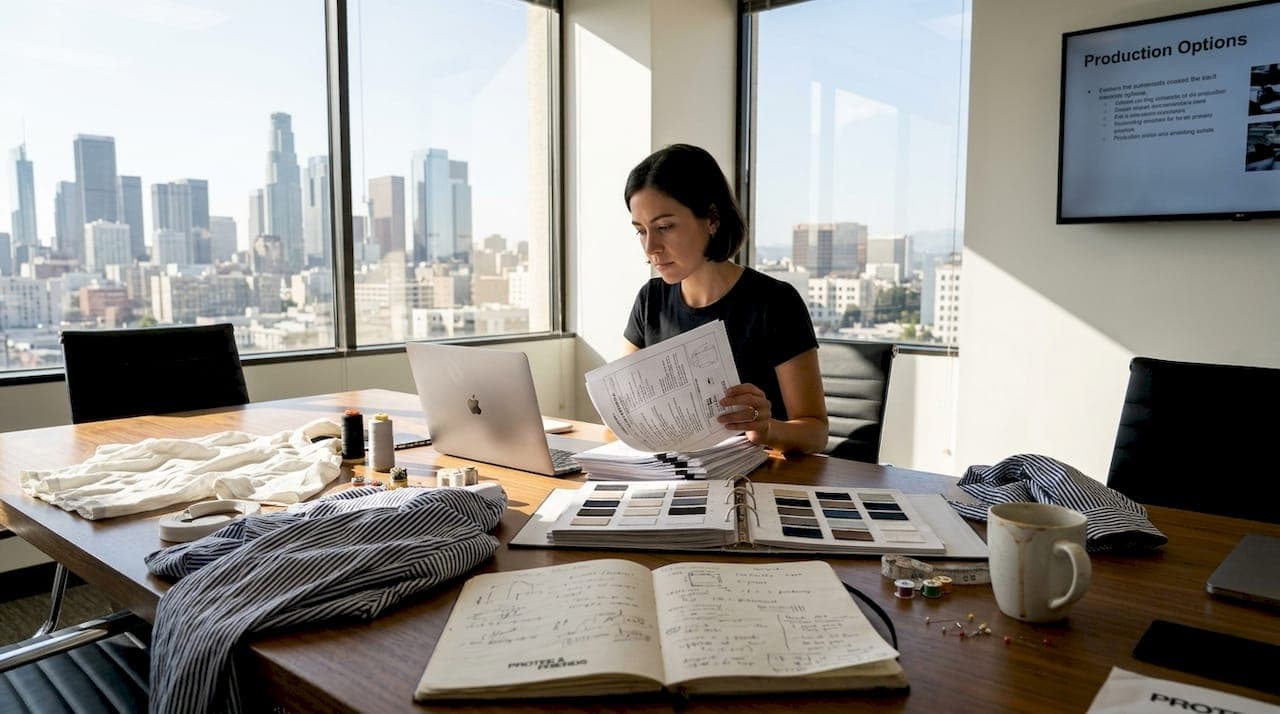
Scaling your fashion brand means finding a reliable apparel factory in Los Angeles that can handle your production needs without chaos or surprises. Many entrepreneurs struggle with inconsistent quality, missed deadlines, and unclear communication when they try to scale beyond their first collection. The right manufacturing partner transforms production from a stressful guessing game into a structured, predictable process. This guide walks you through preparing for factory partnerships, selecting the right manufacturer, managing production workflows, and troubleshooting common challenges so you can scale your brand with confidence and control.
Table of Contents
- Preparing to work with an apparel factory in Los Angeles
- Step-by-step process to select and engage a Los Angeles apparel factory
- Managing production and quality control for scalable results
- Troubleshooting common challenges with Los Angeles apparel factories
- Find your reliable apparel production partner in Los Angeles
- Frequently asked questions about apparel factories in Los Angeles
Key takeaways
| Point | Details |
|---|---|
| Structured preparation ensures smoother partnerships | Define your MOQ, timelines, and quality standards before approaching factories to avoid miscommunication and rework. |
| Clear step-by-step production management reduces risks | Implement regular updates, quality checkpoints, and documentation to maintain control over your manufacturing process. |
| Verification and quality control protect your brand | In-line inspections and final quality checks safeguard product standards and prevent costly mistakes that damage margins. |
| Proactive troubleshooting prevents common delays | Address production challenges early through established escalation paths and strong factory relationships. |
Preparing to work with an apparel factory in Los Angeles
Before you contact a single factory, you need to define exactly what you're asking them to produce. Start by determining your minimum order quantity, realistic timelines, and non-negotiable quality standards. Most Los Angeles factories work with MOQs ranging from 100 to 500 units per style, depending on the complexity and category. If you're unclear about your requirements, factories will fill in the gaps with their assumptions, which rarely match your vision.
Understanding manufacturing terms is critical for clear communication with factories. Learn the difference between cut-make-trim (CMT) services, where you supply fabric, and full-package production, where the factory sources materials. Know terms like grading, marker making, and first article inspection so you can discuss production intelligently. This vocabulary prevents misunderstandings that lead to delays and cost overruns.
Prepare comprehensive tech packs that include flat sketches, construction details, measurements, fabric specifications, and trim callouts. Incomplete tech packs force factories to guess, resulting in samples that miss the mark and require expensive revisions. Your tech pack should answer every question about how to construct the garment before production begins. Include stitch types, seam allowances, and finishing details.
Set realistic timelines that account for each production phase. Pattern making typically takes one to two weeks. First samples require another two to three weeks. Fit corrections and revisions add one to two weeks per round. Bulk production for 200 to 500 units runs four to eight weeks depending on complexity. Rush timelines compress these phases but increase costs and error rates.
Pro Tip: Create a production calendar that maps backward from your launch date, adding buffer time for unexpected delays. Most successful brands build in 20% extra time beyond the factory's quoted lead times.
Essential preparation checklist:
- Define MOQ requirements for each style
- Prepare complete tech packs with all construction details
- Establish quality benchmarks and acceptance criteria
- Set realistic production timelines with buffer periods
- Gather fabric swatches and trim samples for reference
| Production Service | What's Included | Best For |
|---|---|---|
| Cut-Make-Trim | Cutting, sewing, finishing | Brands with fabric sourcing capabilities |
| Full Package | Fabric sourcing, production, quality control | Brands wanting end-to-end manufacturing |
| Sample Development | Pattern making, fit samples, revisions | Testing designs before bulk production |
Step-by-step process to select and engage a Los Angeles apparel factory
Start your search by identifying factories that specialize in your specific apparel category and production scale. A factory that excels at denim may struggle with delicate knitwear. One that handles 10,000-unit runs might not give proper attention to 200-unit orders. Research online directories, attend industry trade shows, and ask for referrals from other brand owners in your network.
Request detailed quotes from three to five factories that match your requirements. A comprehensive quote should break down costs per unit, fabric minimums, sampling fees, payment terms, and lead times for each production phase. Compare not just prices but also what services each factory includes. Some quotes cover only CMT while others include pattern making, grading, and quality inspections.
Visiting factories and reviewing sample runs ensures quality and fit are on point. Schedule in-person visits to inspect factory conditions, meet the production team, and observe their workflow. Look for organized cutting tables, well-maintained equipment, and clean finishing areas. Ask to see samples from current clients in similar categories to assess their workmanship standards.
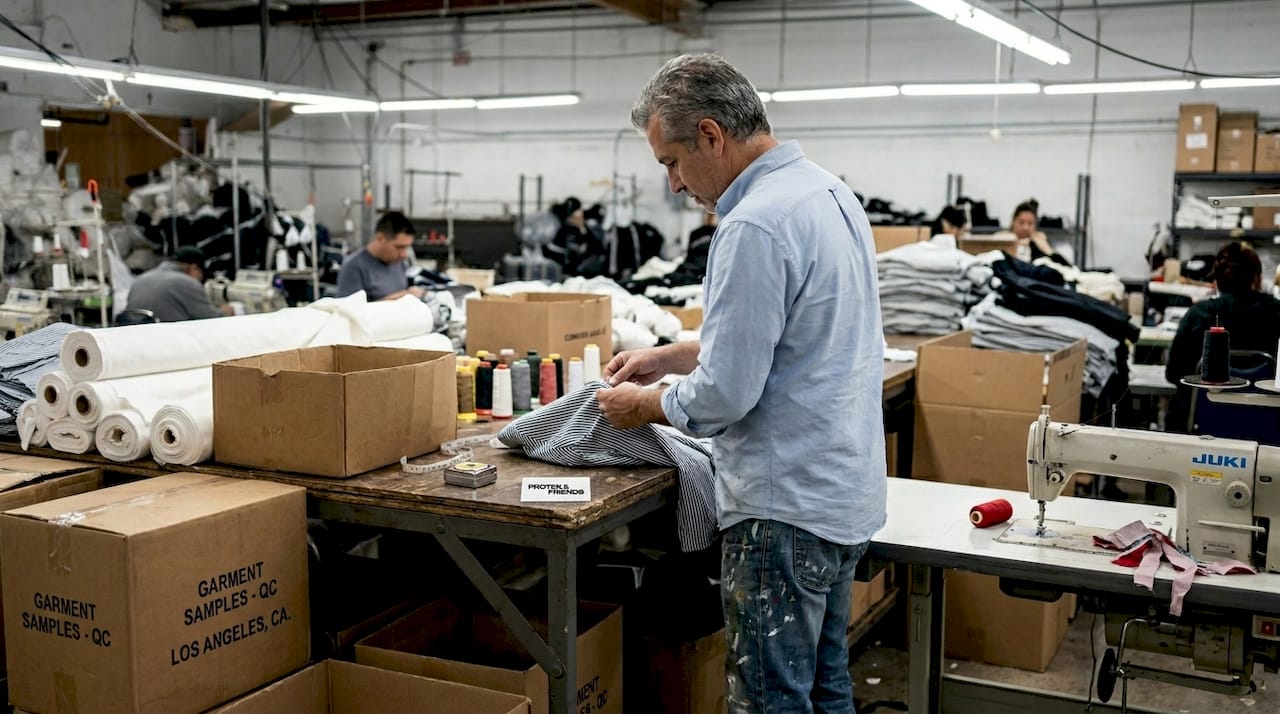
Review sample garments with a critical eye before committing to bulk production. Check stitch quality, seam alignment, fabric hand, and overall construction. Try samples on fit models to verify sizing and proportions. Document any issues with photos and detailed notes. A factory that delivers poor samples will deliver poor bulk production, no matter what they promise.
Negotiate clear contracts that protect both parties and establish expectations. Your agreement should specify payment terms (typically 50% deposit, 50% before shipping), intellectual property rights, delivery timelines, and quality standards. Include penalty clauses for late deliveries and defect rates above agreed thresholds. Define the process for handling disputes and revisions.
Pro Tip: Ask factories for client references and actually call them. Ask about communication responsiveness, timeline accuracy, and how the factory handles problems when they arise.
Factory selection steps:
- Research and shortlist factories specializing in your category
- Request detailed quotes from three to five candidates
- Schedule factory visits to inspect facilities and meet staff
- Review sample garments for quality and construction standards
- Negotiate and finalize contracts with clear terms and protections
- Start with a small test order before committing to large runs
Managing production and quality control for scalable results
Set clear production milestones and establish a communication cadence with your factory. Weekly updates should cover cutting progress, sewing completion rates, and any issues requiring your input. Use production management tools or simple spreadsheets to track order status, fabric arrivals, and quality checkpoint results. Regular communication prevents small problems from becoming major delays.
Implement in-line quality checks at critical production stages rather than waiting until garments are finished. Inspect fabric when it arrives to catch defects before cutting. Check the first few sewn units (first article inspection) to verify construction matches your specs. Review garments after washing or finishing to ensure treatments performed correctly. Catching issues early costs far less than discovering problems after 500 units are complete.
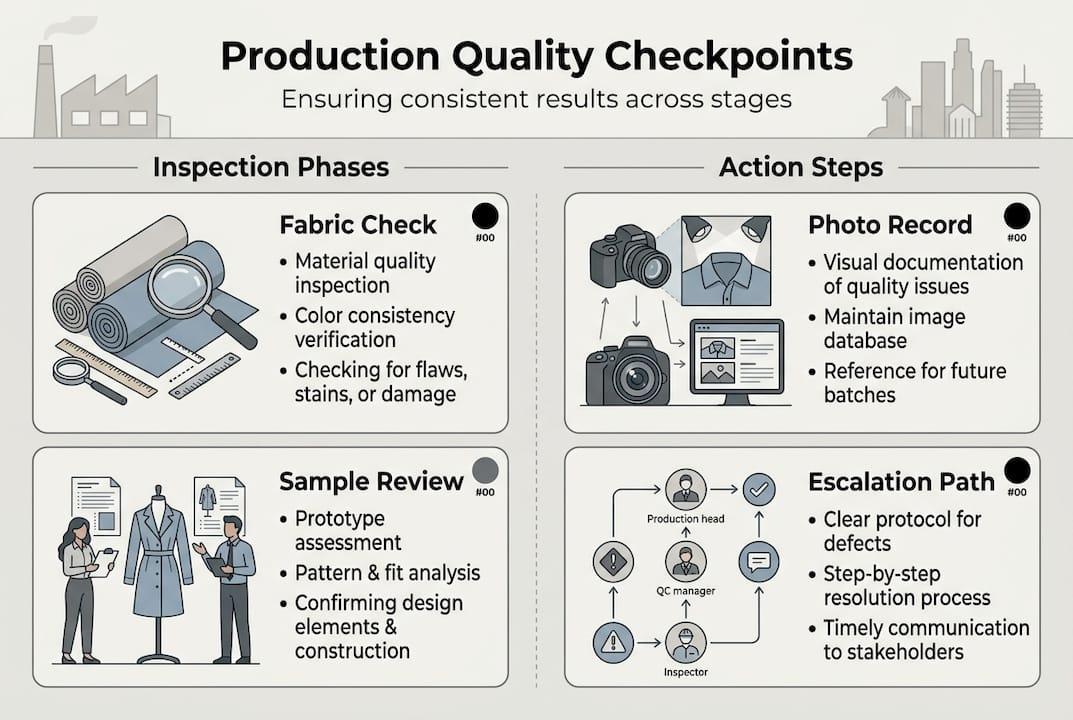
Structured apparel production workflows can cut costs by up to 15% while protecting margins. Create a final quality control checklist aligned with your brand standards. This checklist should cover measurements, stitch quality, fabric defects, trim placement, and finishing details. Assign pass/fail criteria for each checkpoint so inspectors know exactly what constitutes acceptable quality.
Use production management tools to track order status and workflow visibility. Whether you use specialized software or detailed spreadsheets, maintain records of fabric usage, production quantities, defect rates, and timeline adherence. This data helps you identify patterns, negotiate better terms, and plan future orders more accurately.
Address defects or delays promptly through established escalation paths. When problems arise, document them with photos and measurements. Communicate issues to your factory contact immediately rather than waiting. Work together to determine root causes and corrective actions. Factories respect clients who identify problems clearly and work collaboratively toward solutions.
Pro Tip: Build a quality control template that travels with your order. Include photos of approved samples, measurement specs, and acceptance criteria so factory QC teams have clear references throughout production.
Quality control checkpoints:
- Fabric inspection upon arrival at factory
- First article inspection after initial units sewn
- In-line checks during bulk production
- Pre-finishing inspection before washing or treatments
- Final inspection before shipping
| Quality Control Stage | What to Check | Timing |
|---|---|---|
| Fabric Inspection | Defects, color consistency, width | Upon fabric arrival |
| First Article | Construction, measurements, details | After first 3-5 units |
| In-Line Production | Stitch quality, alignment, consistency | During bulk sewing |
| Final Inspection | Complete garment against all specs | Before shipping |
Troubleshooting common challenges with Los Angeles apparel factories
Delayed deliveries rank among the most common production challenges. Factories often quote optimistic timelines that don't account for fabric delays, equipment breakdowns, or competing orders. Combat this by building buffer time into your schedule and requiring weekly progress updates. When delays occur, ask for specific revised timelines and the root cause rather than vague promises.
Inconsistent quality between samples and bulk production frustrates brand owners who approved beautiful samples only to receive subpar bulk goods. This happens when factories use their best sewers for samples but assign less experienced workers to bulk orders. Prevent this by requesting to see bulk production samples (typically the first 10 to 20 units) before the factory completes the entire run.
Miscommunication on specifications causes expensive rework and missed deadlines. Quality control procedures are essential to scale brands while avoiding costly mistakes. Always provide written specifications with photos and diagrams rather than relying on verbal descriptions. Confirm that the factory received and understood your tech pack by asking them to summarize key construction details back to you.
Common production challenges and solutions:
- Delayed deliveries: Build 20% buffer time and require weekly updates
- Quality inconsistency: Request bulk production samples before full run completion
- Spec miscommunication: Provide detailed written documentation with visual references
- Cost overruns: Get itemized quotes and lock pricing before production starts
- Fabric issues: Approve lab dips and strike-offs before bulk fabric orders
| Approach | Reactive Management | Proactive Management |
|---|---|---|
| Communication | Wait for factory updates | Schedule weekly check-ins |
| Quality Control | Inspect finished goods only | Implement in-line checkpoints |
| Problem Solving | Address issues after production | Catch and fix during production |
| Documentation | Verbal instructions | Written specs with photos |
| Timeline Planning | Use factory estimates only | Add buffer time to all phases |
Maintain strong factory relationships by being a good client. Pay invoices on time, provide clear instructions, and make decisions promptly when the factory needs your input. Factories prioritize clients who respect their processes and communicate professionally. When you build trust, factories will accommodate rush orders and go the extra mile during crunch times.
Find your reliable apparel production partner in Los Angeles
Navigating apparel production alone requires significant time and expertise that most fashion entrepreneurs would rather invest in design and marketing. Protek & Friends eliminates production uncertainty by providing structured, full-package clothing production services for brands ready to scale correctly. We handle everything from tech pack review and fabric sourcing to quality control and delivery coordination.
Our hybrid manufacturing model gives you flexibility to produce locally in Los Angeles or overseas in China depending on your timeline, budget, and order volume. We provide transparent pricing breakdowns before you commit, so you know exactly what you're paying for. No surprise costs, no shifting timelines, no chaotic communication. Partner with Protek & Friends to replace production stress with systematic processes that protect your margins and reputation.
Frequently asked questions about apparel factories in Los Angeles
How long does it typically take to produce a collection in LA factories?
Complete production from tech pack approval to finished goods typically takes 10 to 14 weeks for new styles. This includes pattern making (one to two weeks), sample development and revisions (three to four weeks), fabric sourcing (two to three weeks), and bulk production (four to six weeks). Rush services can compress timelines by 20% to 30% but increase costs significantly.
What is the minimum order quantity in most Los Angeles apparel factories?
Most LA factories require 100 to 500 units per style depending on garment complexity and production method. Simple t-shirts or basics may have lower minimums around 100 units, while complex constructed garments like jackets often require 300 to 500 units to justify setup costs. Full-package services typically have higher minimums than CMT arrangements.
How can I ensure quality standards are met when working remotely with a factory?
Implement in-line quality checkpoints with photo documentation sent to you at each stage. Hire a third-party quality control service to conduct on-site inspections during production. Provide detailed quality control checklists with pass/fail criteria and sample garments as references. Video calls during production allow you to see progress and address concerns in real time.
What are common pitfalls when scaling production in Los Angeles?
Underestimating lead times causes rushed production and quality compromises. Incomplete tech packs lead to costly revisions and delays. Choosing factories based solely on price rather than capabilities results in poor quality. Failing to implement quality control checkpoints means discovering defects too late. Not building strong factory relationships reduces your priority during busy seasons. Review the Los Angeles clothing factory guide for detailed strategies.
Can Protek & Friends help new brands with small batch production?
Yes, Protek & Friends works with brands producing 100 to 500 unit runs per style. We specialize in helping fashion entrepreneurs who have launched at least one collection and are ready to scale with professional production systems. Our structured approach works for both small batch testing and larger production runs as your brand grows.