TL;DR:
- The US apparel industry includes over 10,000 factories, mostly small and specialized.
- Clear requirements and strategic directory searches are key to finding the right manufacturer.
- Small factories offer personalized service and better communication, making them ideal for custom orders.
Finding the right clothing manufacturer in the U.S. can feel like searching for a single thread in a warehouse full of fabric. Your choice directly affects product quality, delivery timelines, and ultimately your brand's reputation. With over 10,000 manufacturers operating across the country, the options are overwhelming and the stakes are high. This guide walks you through a clear, step-by-step process: understanding the landscape, defining your needs, using the right search tools, and vetting candidates before you commit. If you want to produce correctly and avoid costly mistakes, this is where you start.
Table of Contents
- Understand the US clothing manufacturing landscape
- Set your requirements before you start searching
- Find US manufacturers: top directories and platforms
- Vetting and contacting US manufacturers
- A fresh perspective on American clothing manufacturing
- Partner with experts for faster, high-quality results
- Frequently asked questions
Key Takeaways
| Point | Details |
|---|---|
| Know your requirements | Define apparel type, order size, and essential services before searching for manufacturers. |
| Use trusted directories | Platforms like Maker's Row and Thomasnet help filter US factories by specialty and location. |
| Prioritize small factories | Over 75% of US manufacturers are small and ideal for niche or custom production runs. |
| Vetting is critical | Always verify certifications, references, and sample quality before confirming production. |
Understand the US clothing manufacturing landscape
The U.S. apparel industry is larger and more varied than most brand owners realize. Before you start making calls or filling out contact forms, it helps to understand how the industry is structured and where the best opportunities actually live.
The numbers tell a clear story. The U.S. apparel industry includes over 10,000 factories employing more than 240,000 workers and generating roughly $160 billion in annual sales. That scale means there is a manufacturer for almost every product category, price point, and production volume. The challenge is knowing where to look.
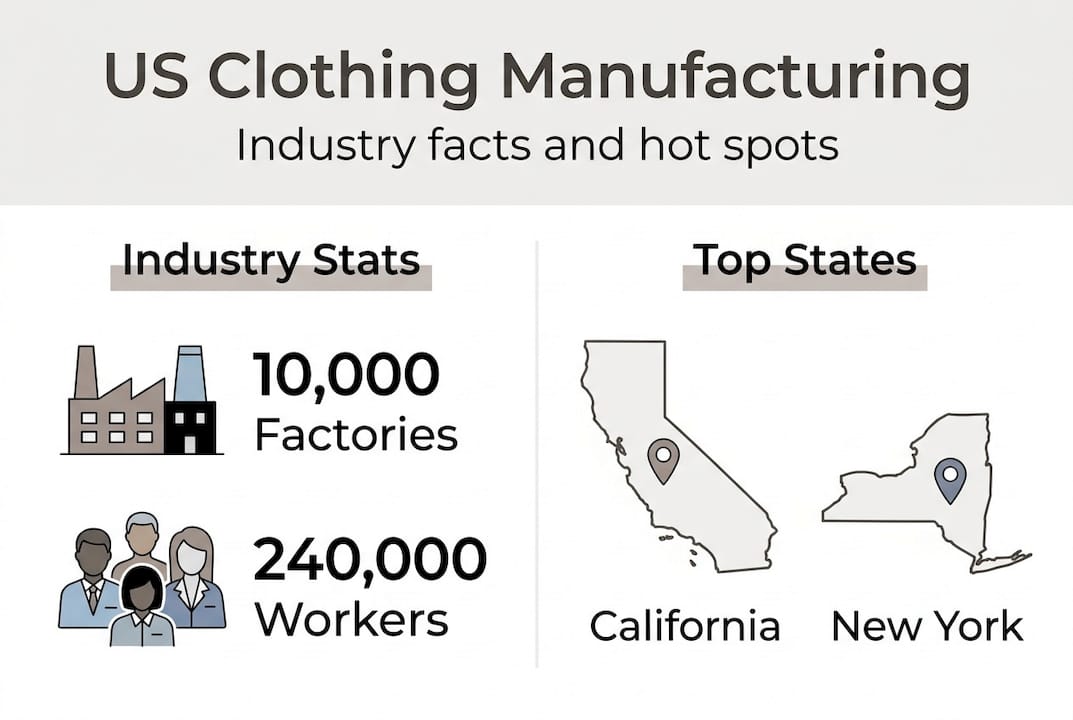
Top U.S. manufacturing hubs by state:
| State | Key Cities | Share of Industry |
|---|---|---|
| California | Los Angeles, San Francisco | 8.4% |
| New York | New York City, Buffalo | 8.0% |
| Florida | Miami, Orlando | 5.6% |
| Texas | Dallas, Houston | Significant |
| Pennsylvania | Philadelphia, Pittsburgh | Significant |
Source: U.S. apparel manufacturing data
Los Angeles stands out as the most active hub for fashion brands. If you are sourcing cut and sew, denim, or specialty finishes, LA clothing manufacturers tend to offer the deepest concentration of skilled workers and fabric suppliers in one place.
One of the most important structural facts about U.S. manufacturing is factory size. The majority of U.S. factories are small operations. This is both an advantage and a limitation depending on your goals.
Industry note: Most U.S. apparel factories run lean teams focused on quality and flexibility rather than mass volume. This makes them ideal for custom work, but it also means capacity can fill up fast.
Here is how geography and factory size affect your sourcing strategy:
- Smaller factories offer more personalized service, faster communication, and flexibility for custom runs
- Coastal hubs (LA, NYC) give you access to trend-forward production and specialized fabric sourcing
- Interior states may offer lower labor costs but fewer specialty capabilities
- Regional clusters often specialize in specific categories like denim (LA) or activewear (Southeast)
- Factory proximity to your team reduces travel costs for in-person QC visits
When you explore the full range of top US clothing manufacturers, you will notice that the best fit for your brand depends far more on specialization and communication style than on size alone.
Set your requirements before you start searching
With a clear picture of the U.S. landscape, the next step is to identify exactly what your brand needs from a manufacturer. Jumping into directories without a defined set of requirements is one of the most common and costly mistakes brand owners make.
The U.S. textile industry is made up largely of small and micro factories, with 76% employing fewer than 10 people. That means most factories specialize. A factory that excels at knitwear may not touch woven denim. One that handles large runs may not accommodate a 100-piece startup order. Knowing your needs upfront saves you weeks of back-and-forth.
Start by mapping out your core production requirements:
- Apparel category: Cut and sew, knitwear, denim, activewear, outerwear
- Minimum order quantity (MOQ): Are you starting small or scaling into thousands of units?
- Certifications needed: GOTS, OEKO-TEX, Fair Trade, or domestic content requirements
- Services required: Pattern making, sampling, dyeing, finishing, private labeling
- Timeline: How many weeks do you have from sample approval to delivery?
- Budget range: Cost per unit, sampling fees, and tooling costs
- Communication expectations: Response time, documentation, reporting style
Once you have that list, separate your needs from your wants. Needs are non-negotiable. Wants are nice to have but not deal-breakers. This simple exercise cuts your candidate list dramatically before you even start searching.
If you are early stage and concerned about volume, resources on no minimum manufacturers can help you identify factories that work with smaller brands. For a broader framework on production planning, the clothing factory guide for startups covers how to structure your first production run with fewer surprises.
Pro Tip: Always place quality control and clear communication at the top of your requirements list, not the bottom. A factory that produces beautiful samples but goes silent during bulk production is a liability, not a partner.
Find US manufacturers: top directories and platforms
Once you know what matters for your brand, you are ready to use the industry's best search platforms. The good news is that several strong directories exist specifically for apparel sourcing. The key is using them strategically rather than just browsing.
Specialized directories like Maker's Row, Thomasnet, Sewport, Kompass, and CottonWorks allow you to filter by location, production capabilities, and product category. Each platform has a different strength.
Platform comparison:
| Platform | Best For | Key Feature |
|---|---|---|
| Maker's Row | U.S.-only brands | Curated domestic factories |
| Thomasnet | Verified suppliers | 1,180+ clothing suppliers listed |
| Sewport | Global + U.S. search | RFQ system built in |
| Kompass | B2B sourcing | Detailed company profiles |
| CottonWorks | Cotton-focused brands | Fiber-to-fabric sourcing support |
Data point: Thomasnet lists over 1,180 U.S. clothing suppliers with verified contact information and production capabilities, making it one of the most reliable starting points for domestic sourcing.
Here is a step-by-step search workflow to use across these platforms:
- Set location filters first. Start with your preferred state or region before applying any other filter.
- Filter by product category. Use the most specific category available, such as "cut and sew" rather than just "apparel."
- Check MOQ and capacity information. Many listings include this. If not, note it as a question for outreach.
- Review company history and years in business. Factories with 5 or more years of operation tend to be more stable.
- Flag red flags early. No website, no photos of production, and vague capability descriptions are warning signs.
- Build a shortlist of 8 to 12 candidates. You will narrow this down during vetting.
For a curated starting point, the American clothing manufacturers list and a broader look at apparel manufacturing options can help you benchmark what strong candidates look like before you start outreach.
Vetting and contacting US manufacturers
With a shortlist of possible factories, your next move is to carefully vet each candidate and launch initial contact. This stage separates brands that produce successfully from those that waste money on bad fits.
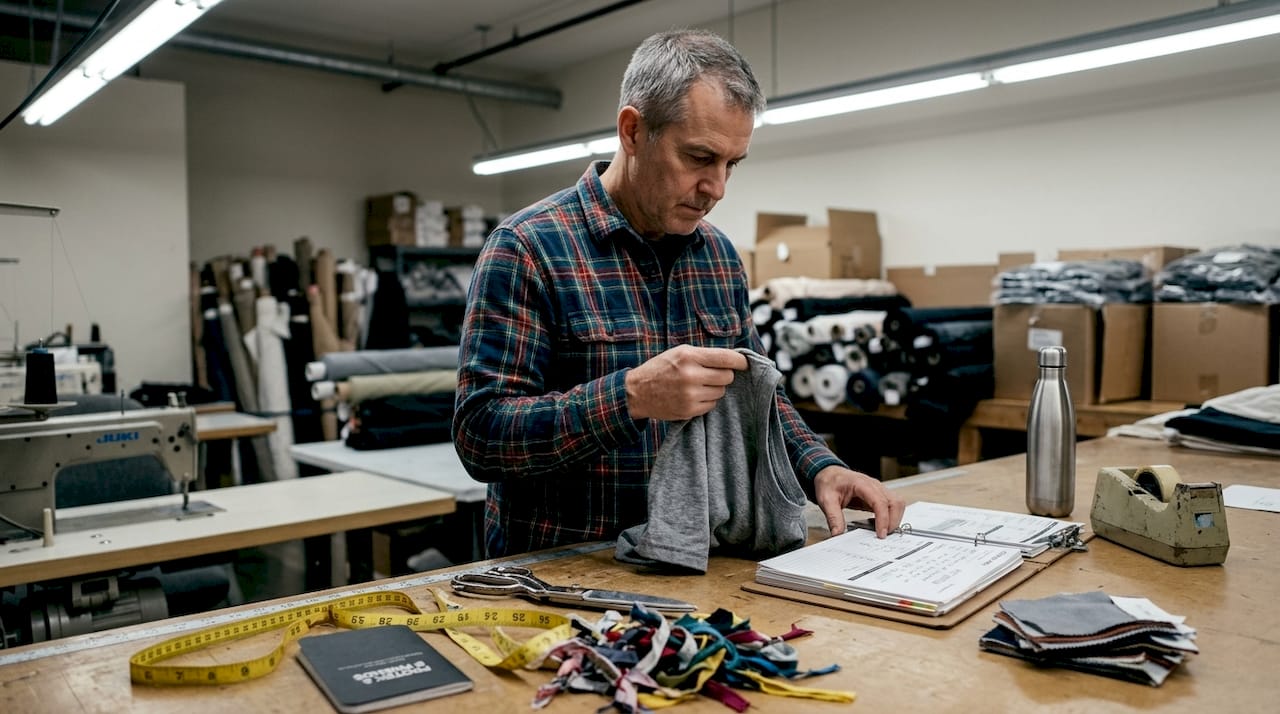
According to industry data, the majority of U.S. factories are small operations with fewer than 10 employees. That means your vetting process needs to account for limited bandwidth on their end. Respect their time and come prepared.
Research checklist before making contact:
- Verify years in business and ownership history
- Check for relevant certifications (GOTS, WRAP, or domestic content)
- Look for customer reviews or references from brands in your category
- Review any available portfolio or production photos
- Confirm physical address and visit Google Maps or Street View
- Search the business name in state business registries
Once you have done basic research, reach out with a clear, concise brief. Include your product category, approximate volume, timeline, and one or two specific questions. Avoid sending a wall of text. Factories that receive a focused, professional inquiry respond faster and take you more seriously.
Key questions to ask before ordering samples:
- What product categories do you specialize in?
- What is your current production capacity and lead time?
- Can you share references from similar fashion brands?
- What does your sampling process look like and what are the fees?
- How do you handle quality control during bulk production?
For brands focused on US clothing production quality control, asking about QC processes early is essential. If you are working with specialty finishes, reviewing garment dyeing tips before your first factory conversation will help you ask smarter questions.
Pro Tip: Small factories often operate on slower communication cycles than large vendors. If you do not hear back within five business days, one polite follow-up is appropriate. Aggressive follow-up damages the relationship before it starts.
Document every conversation. Keep a simple spreadsheet with each factory's name, contact, capabilities, MOQ, pricing range, and your notes from each interaction. When it is time to compare proposals, you will have everything in one place.
A fresh perspective on American clothing manufacturing
Here is something most sourcing guides will not tell you: the obsession with finding a big factory is often the wrong instinct. Many brand owners assume that a larger factory means better quality, more reliability, and easier scaling. In my experience, that assumption causes more problems than it solves.
Small U.S. factories often offer something that large operations simply cannot: genuine attention. When your run is one of three projects on the floor instead of one of three hundred, communication is faster, fit corrections happen quicker, and accountability is real. You are not a purchase order number. You are a client.
The brands that learn from small US manufacturers and adapt their processes accordingly tend to produce better first collections. They build real relationships. They get honest feedback on their tech packs. They are not waiting in a queue.
The hidden risk is expecting small factories to behave like large ones. If you bring a 500-piece order to a 10-person shop and expect 72-hour turnarounds on every revision, you will create friction. The smarter move is to align your timelines and documentation to their workflow, not the other way around. Structure your brand's process to meet them where they are, and the results will consistently exceed what a larger, less attentive factory would deliver.
Partner with experts for faster, high-quality results
If you want to streamline the entire process and gain a production partner, expert help is available. Navigating directories, vetting factories, and managing sampling cycles takes real time, and mistakes at any stage are expensive.
At Protek & Friends, we operate as a full-package production partner for U.S. fashion brands. Our hybrid model gives you access to both domestic and overseas production, with clear documentation at every stage and structured QC built into the process. We handle design review, fabric sourcing, sampling, fit corrections, cost breakdowns, and bulk production management. Our clothing production services are built for brands that are ready to scale with systems, not guesswork. If you are ready to produce your next collection with clarity and control, let's talk.
Frequently asked questions
What is the minimum order quantity for US clothing manufacturers?
Most U.S. clothing manufacturers offer low minimum order quantities, often starting at 50 to 100 pieces, because 76% of factories are small or micro operations suited to niche and custom production runs.
How can I verify a US manufacturer's reputation and reliability?
Check certifications, ask for customer references, review sample work, and search the business in public directories. Platforms like Thomasnet and Maker's Row include verified profiles that make initial screening faster and more reliable.
Are US clothing manufacturers more expensive than overseas options?
U.S. manufacturing typically costs more per unit, but the trade-offs in quality, communication, and speed to market can offset that gap. Major hubs like LA and NYC also offer access to specialized skills that are harder to source internationally.
Should I visit US manufacturers in person before placing an order?
Visiting is ideal when possible, but many strong partnerships begin remotely through video calls, virtual factory tours, and mailed samples before any in-person meeting takes place.