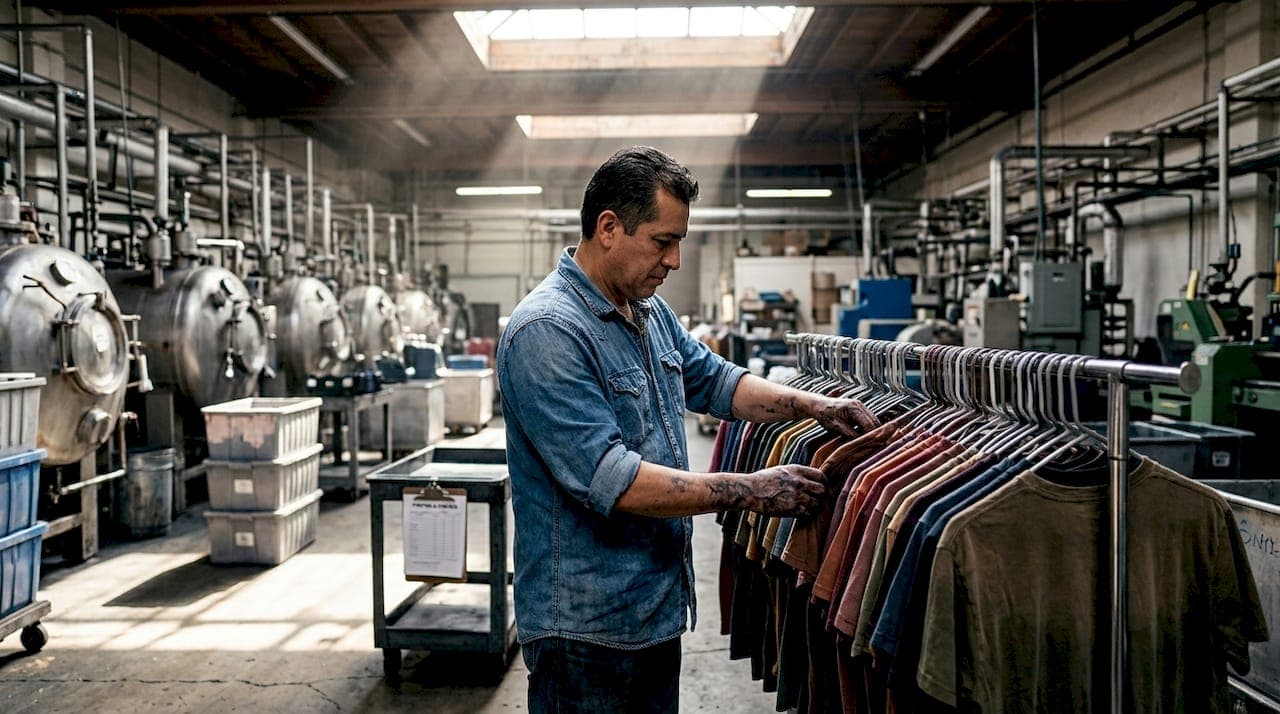
Garment dyeing is behind some of the most recognizable looks in fashion right now, from sun-faded tees to richly pigmented fleece. But most brand owners treat it like a simple finishing step, when it's actually a full production discipline with its own rules, risks, and rewards. If you've already launched a collection and you're ready to produce garment-dyed styles with real consistency, this guide breaks down exactly how the process works, what can go wrong, and how to find a manufacturing partner in Los Angeles who won't waste your time or your budget. Garment dye excels for vintage and washed looks while offering flexibility for small batches and fast trend response.
Table of Contents
- What is garment dye manufacturing?
- Inside the garment dyeing process in Los Angeles
- Key benefits and challenges for fashion brands
- Garment dye vs. piece dye: When and why to choose each
- How to choose the right garment dye manufacturing partner in Los Angeles
- Partner with a trusted Los Angeles garment dye manufacturer
- Frequently asked questions
Key Takeaways
| Point | Details |
|---|---|
| Flexible production | Garment dyeing enables small batch production and fast response to trends. |
| Reduced waste | You can cut fabric waste by about 15% compared to traditional dyeing. |
| Ideal for vintage looks | Garment dyeing achieves unique, washed styles popular in Los Angeles fashion. |
| Choose partners wisely | Selecting an experienced factory prevents common issues like shrinkage and uneven color. |
| Understand fiber limitations | Stick with 100% cotton and avoid synthetics or mixed trims for best results. |
What is garment dye manufacturing?
Garment dyeing is the process of dyeing a finished, assembled garment rather than dyeing the fabric before it's cut and sewn. That distinction matters more than most people realize. With piece dyeing, you're working with fabric yardage before construction. With garment dyeing, the entire finished piece goes into the dye bath, which changes how color absorbs, how seams behave, and how the final product looks and feels.
There are four main dye types used in garment manufacturing: sulfur dyes (great for earthy, muted tones on cotton), pigment dyes (surface-level color with a worn-in look), reactive dyes (bright, wash-fast color that bonds chemically to fiber), and direct dyes (simple application, lower wash fastness). Each has a different use case depending on the look you're going for and the fabric you're working with.
Los Angeles brands lean heavily on garment dyeing because it supports small, flexible production runs. You can cut and sew in one neutral base fabric, then split the batch into multiple colorways at the dye stage. That kind of flexibility is hard to get with traditional piece dyeing. As garment dyeing explained in detail, the process involves batching by fabric and style, specific dye types, and precise pre- and post-treatments that determine the final result.
Items commonly produced through garment dyeing include:
- Heavyweight cotton tees and long sleeves
- Fleece sweatshirts and hoodies
- Twill pants and shorts
- Canvas tote bags and accessories
- Denim jackets and overshirts
- Terry cloth and waffle-knit pieces
"Garment dye excels for vintage and washed looks, and offers real flexibility for small batches and trend-driven production."
For brands building reliable factory processes in Los Angeles, garment dyeing is often the right call when you want color variety without committing to large fabric minimums upfront. It's also a strong tool for scaling production with quality once your core styles are locked in.
Inside the garment dyeing process in Los Angeles
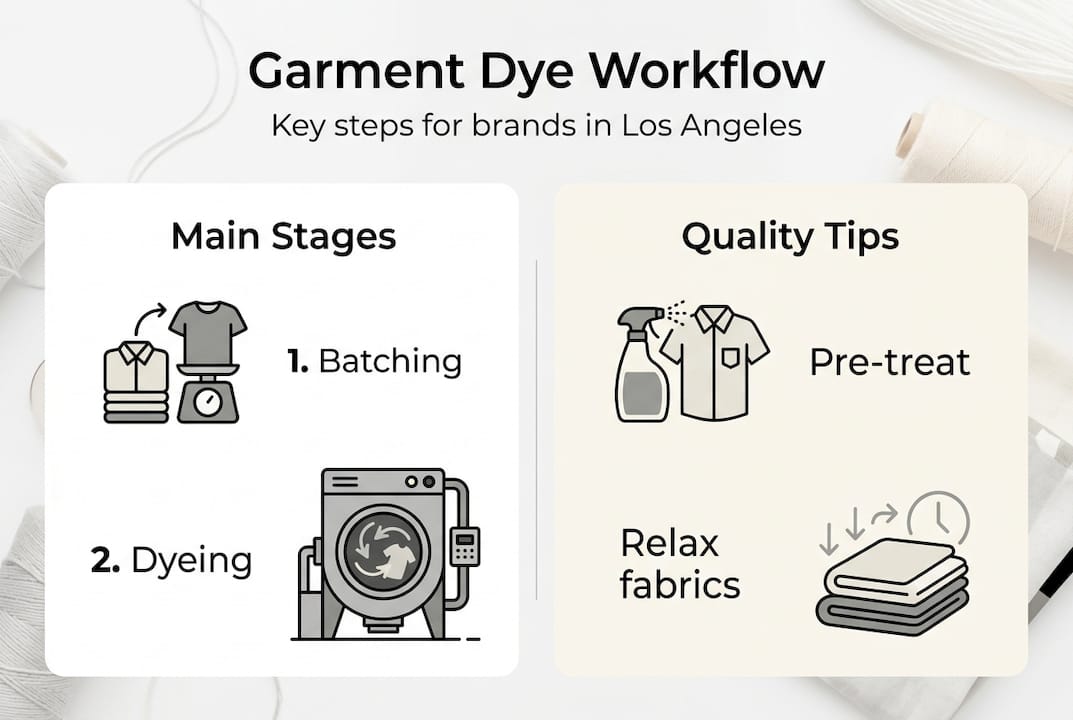
The garment dye workflow has several distinct stages, and skipping or rushing any one of them is where most quality problems start. Here's how a well-run production sequence looks:
- Batching — Garments are grouped by fabric type, weight, and construction. LA factories often batch by client or by trend cycle to keep colorways consistent across a run.
- Pre-treatment — Fabrics are scoured (cleaned) to remove oils, sizing agents, and any residue from construction. This step directly affects how evenly the dye absorbs.
- Relaxing — Garments are soaked and allowed to relax before entering the dye bath. This reduces tension in the fabric and minimizes post-dye shrinkage.
- Dyeing — Garments go into the dye machine with the chosen dye type, water, and auxiliary chemicals. Temperature, time, and liquor ratio (the ratio of water to fabric) are all controlled carefully.
- Post-treatment — After dyeing, garments are rinsed, softened, and sometimes treated for color fastness. This stage also includes any enzyme washing or stone washing if a worn finish is the goal.
- Finishing and QC — Garments are dried, pressed, and inspected for shade consistency, shrinkage, and defects before moving to packing.
As outlined in the steps of garment dyeing, each stage from batching through post-treatment plays a direct role in the final color result and garment quality.
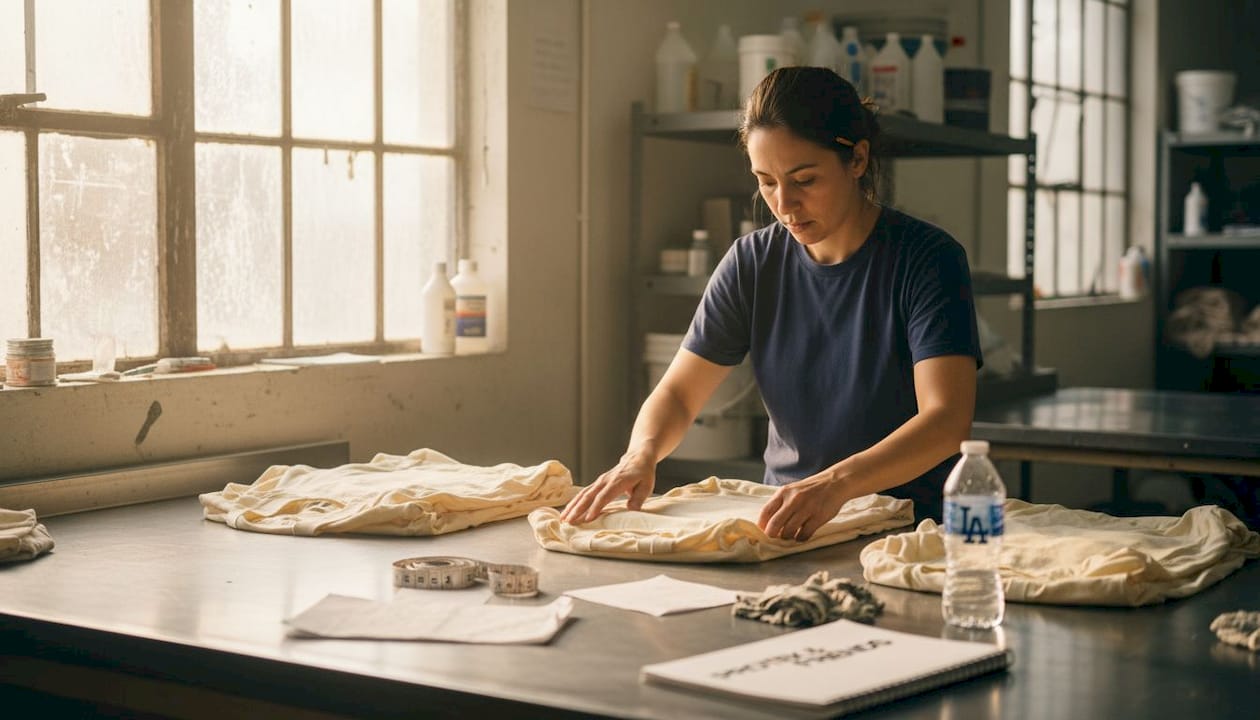
Pro Tip: Always pre-treat and relax your fabrics for 24 to 48 hours before dyeing. Skipping this step is the number one cause of uneven color and unexpected shrinkage in finished garments.
Here's a quick comparison of the four main dye types used in LA garment production:
| Dye type | Typical look | Best fabric | Use case |
|---|---|---|---|
| Sulfur | Muted, earthy tones | 100% cotton | Workwear, vintage styles |
| Pigment | Faded, surface color | Cotton, canvas | Washed tees, casual wear |
| Reactive | Bright, saturated | Cotton, linen | Bold colorways, basics |
| Direct | Flat, moderate depth | Cotton, rayon | Budget runs, simple solids |
Building structured workflows around these stages is what separates a clean garment dye run from a costly one. If you're earlier in your production journey, startup production guidance can help you understand how to sequence these decisions before you commit to bulk.
Key benefits and challenges for fashion brands
Garment dyeing has real advantages for emerging brands, but it also comes with tradeoffs that can hurt you if you're not prepared. Let's be direct about both.
The advantages are significant. Garment dyeing gives you colorway flexibility late in the production cycle, which means you can respond to trend shifts without being locked into fabric commitments made months earlier. It also reduces fabric waste. Fabric waste reduction of around 15% is a documented benefit of garment dyeing compared to traditional piece dyeing, along with a lower liquor ratio that uses less water and fewer chemicals per unit.
Key benefits for LA fashion brands:
- Late-stage color decisions — Split one base fabric into multiple colorways at the dye stage
- Trend responsiveness — Shorter lead times for color changes compared to piece dyeing
- Unique aesthetics — Vintage, washed, and lived-in looks that are hard to replicate with piece dye
- Smaller minimums — Better suited for runs of 50 to 300 units per colorway
- Waste reduction — Less overproduction of fabric yardage in specific colors
But the advantages and disadvantages are real on both sides. Cotton garments can shrink 5 to 10% during the dye process if pre-treatment is skipped. Synthetic fibers and Lycra blends don't absorb dye evenly and can be damaged by the heat and chemicals involved. Metal zippers, plastic buttons, and mixed-fiber trims can react unpredictably in the dye bath, causing discoloration or hardware damage.
| Factor | Advantage | Challenge |
|---|---|---|
| Color flexibility | Split colorways late in production | Shade variation between batches |
| Fabric waste | ~15% less waste than piece dyeing | Requires careful pre-treatment |
| Aesthetics | Vintage and washed finishes | Harder to achieve bright, uniform color |
| Trims and hardware | Works well with natural fiber trims | Metal and synthetic trims can be damaged |
| Shrinkage control | Manageable with proper prep | Unpredictable without pre-treatment |
Pro Tip: Add 5 to 10% to your pattern measurements for cotton styles going through garment dye. This accounts for expected shrinkage and keeps your finished sizing accurate.
Understanding these cost and waste benefits helps you make smarter decisions at the planning stage. If you're still getting familiar with production terminology, reviewing production terms explained will give you the vocabulary to have sharper conversations with your factory.
Garment dye vs. piece dye: When and why to choose each
Choosing between garment dye and piece dye isn't about which method is better. It's about which one fits your production goals, your batch size, and the aesthetic you're building toward.
Piece dyeing is more cost-effective for large, uniform runs where color is locked in early. Garment dyeing enables vintage and custom looks with flexibility for smaller production quantities. Both have a place in a growing brand's toolkit.
| Factor | Garment dye | Piece dye |
|---|---|---|
| Batch size | 50 to 500 units | 500+ units |
| Cost per unit | Higher | Lower at scale |
| Color flexibility | High (late-stage decisions) | Low (locked in at fabric stage) |
| Aesthetic range | Vintage, washed, lived-in | Uniform, clean, consistent |
| Lead time | Shorter for color changes | Longer setup, faster bulk |
| Best for | Trend-driven, small runs | Basics, large wholesale orders |
When to choose garment dye:
- You want a vintage, washed, or pigment-dyed finish
- Your run is under 300 units per colorway
- You need to test multiple colorways without committing to fabric yardage
- Your brand identity is built around unique, hard-to-replicate aesthetics
- You're producing in Los Angeles and need fast turnaround on trend-driven styles
Smaller LA brands consistently choose garment dye because it matches how they actually operate: lean, trend-aware, and focused on standing out. Choosing a factory that understands this production style is just as important as the method itself. And when you're ready to grow, working with a partner experienced in scaling manufacturing reliably means your systems grow with you.
How to choose the right garment dye manufacturing partner in Los Angeles
Not every factory that offers garment dyeing is equipped to do it well. Quality outcomes depend not just on the dye machine, but on fabric prep, batch control, and experience handling shrinkage and edge cases. Here's how to screen a potential partner before you commit.
Steps to vet a garment dye manufacturer:
- Request a sample run — Ask for a dyed sample in your chosen fabric and colorway before placing any bulk order. A factory that won't do samples is a red flag.
- Ask about pre-treatment protocols — Do they scour and relax fabrics before dyeing? How long? This tells you immediately whether they understand the process.
- Check batch control documentation — Can they show you dye lot records and shade approval sign-offs? Structured factories document this. Chaotic ones don't.
- Ask about shrinkage testing — Do they test for shrinkage before cutting patterns? If not, your sizing will be off in bulk.
- Verify trim and hardware compatibility — Do they assess your zippers, buttons, and labels before dyeing? Mixed trims are a common source of defects.
- Ask for references from similar brands — A factory experienced with small LA brands will have relevant references. Ask specifically about garment dye projects.
Red flags to watch for:
- No pre-treatment step in their workflow
- Can't explain their dye lot control process
- No shrinkage testing before pattern cutting
- Vague communication about timelines and costs
- No documentation shared before you pay
- Unwilling to do a sample run before bulk
Local LA considerations matter here too. You want a partner with flexible MOQs (ideally starting at 50 to 100 units), experience with trend-driven production cycles, and the ability to handle full-package work including fabric sourcing and finishing. Reviewing what to look for in an LA manufacturer selection process will sharpen your screening criteria. If you're comparing options, understanding what full package factories actually offer versus standard cut-and-sew shops will save you from mismatched expectations.
Partner with a trusted Los Angeles garment dye manufacturer
If you've made it through this guide, you already know more about garment dyeing than most brand owners who are placing orders right now. That knowledge only helps you if you work with a partner who operates at the same level of discipline.
At Protek & Friends, we work with Los Angeles fashion brands that are ready to produce correctly, not just quickly. Our structured process covers everything from fabric sourcing and pre-treatment planning to batch control, QC checks, and delivery coordination. We handle garment dye as part of our full-package Los Angeles production services, with clear documentation at every stage so you always know where your order stands. If you're ready to run a garment-dyed collection without the guesswork, reach out to book a discovery call or request a sample run.
Frequently asked questions
What is the minimum order quantity (MOQ) for garment dye manufacturing in Los Angeles?
MOQs typically start around 50 pieces but vary by factory, dye type, and batch complexity. Smaller LA manufacturers often offer more flexibility than larger overseas operations.
How can I prevent uneven dyeing and shrinkage with garment dye?
Always pre-treat and relax your fabric before dyeing, test each batch for shrinkage, and adjust your patterns by 5 to 10% for cotton styles to account for expected size change.
What materials are best and worst for garment dye?
100% cotton absorbs garment dye most evenly and predictably. Lycra, elastane, and mixed-fiber garments with synthetic trims are the riskiest choices due to uneven absorption and potential heat damage.
Is garment dyeing more sustainable than traditional fabric dyeing?
Yes. Garment dyeing produces around 15% less fabric waste than piece dyeing and uses a lower liquor ratio, which means less water and fewer chemicals per unit produced.