Poor communication costs manufacturers an average of $1.2M annually, yet most fashion brand leaders overlook these breakdowns as the root cause of production delays, quality failures, and margin erosion. When your team loses critical details during shift changes or relies on fragmented channels, you're not just facing inefficiency. You're bleeding money on rework, late deliveries, and damaged client relationships. This guide reveals the five communication failure patterns that sabotage scalable manufacturing, then walks you through proven team structures, digital tools, and handover practices that eliminate costly errors and build systematic quality control into every production run.
Table of Contents
- Why communication breakdowns cost fashion manufacturing millions
- How team structures and digital tools enhance communication quality
- Structured handovers and cross-functional collaboration for consistent quality
- Scaling communication across multi-plant and global fashion supply chains
- Streamline your apparel production communication with Protek & Friends
- Frequently asked questions about communication in manufacturing
Key takeaways
| Point | Details |
|---|---|
| Communication failures drain profits | Manufacturers lose $1.2M yearly through coordination waste and repeated errors caused by poor information flow. |
| Five breakdown patterns dominate | Undocumented handoffs, incomplete radio logs, inaccessible paper records, fragmented channels, and team silos create most issues. |
| Self-managed teams outperform hierarchies | Higher communication quality and frequency in self-managed structures reduce automation failures and production defects. |
| Digital platforms unify quality control | Real-time dashboards consolidate inspections, corrective actions, and supplier data to catch defects earlier. |
| Structured handovers prevent information loss | Digital shift transitions retain essential details that rushed verbal reports miss. |
Why communication breakdowns cost fashion manufacturing millions
Communication breakdowns cost manufacturers an average of $1.2M annually through coordination waste and repeated problems. Fashion production amplifies these losses because every garment involves multiple handoffs across design review, fabric sourcing, sample correction, bulk cutting, sewing, finishing, and quality inspection. When information drops during any transition, you face rework costs, delayed shipments, and strained client trust.
Five key breakdown patterns dominate manufacturing environments: undocumented verbal handoffs, incomplete radio communication, inaccessible paper logs, fragmented digital channels, and departmental silos. Each pattern creates a different failure mode, but all share the same outcome: lost information that forces teams to guess, repeat work, or ship defective products.
Fashion manufacturing is especially vulnerable because quality control demands precise communication across specialized roles. Your pattern maker needs exact fabric specs from your sourcing team. Your sample room must relay fit corrections to your bulk production manager. Your QC inspector has to document defects so your factory can implement corrective actions before the next run. When any link breaks, fashion production oversight becomes reactive instead of preventive.
Undocumented verbal handoffs create the most expensive failures because critical details vanish the moment the conversation ends, forcing the next shift or team member to reconstruct decisions from incomplete context.
Consider what happens during a typical shift change without structured handovers. The outgoing supervisor mentions a fabric tension issue verbally, but the incoming lead doesn't write it down. By the time the problem resurfaces two hours later, the team has already cut 200 garments with the wrong tension, requiring full rework. That single communication gap just cost you thousands in labor and materials.
Understanding these failure modes is the first step toward fixing them. You can't improve what you don't measure, and you can't measure what you don't document. The next section explains how modern team structures and digital tools transform communication from a liability into a competitive advantage.
How team structures and digital tools enhance communication quality
Self-managed teams communicate more frequently and with higher quality than hierarchical teams, resulting in fewer production errors. When your production floor operates with clear ownership and direct accountability, team members share information proactively instead of waiting for management directives. This shift reduces the coordination overhead that slows hierarchical structures and creates communication bottlenecks.
Higher communication quality directly impacts your bottom line. Teams that share precise, timely information experience fewer automation failures, catch defects earlier in the production cycle, and resolve problems before they compound. In fashion manufacturing, where a single miscommunication about seam allowances or fabric stretch can ruin an entire batch, communication quality isn't a soft skill. It's a financial imperative.
Digital tools unify QC processes in apparel production, reducing late defect detection. Instead of juggling paper inspection logs, email threads, and spreadsheets across your design team, sample room, and factory floor, unified platforms consolidate inspections, CAPA (corrective and preventive actions), and supplier assessments into real-time dashboards. Everyone sees the same data simultaneously, eliminating the version control chaos that plagues fragmented systems.

Implementing unified digital systems helps you detect defects earlier because information flows instantly from inspection to corrective action. When your QC inspector photographs a stitching defect and uploads it to your shared platform, your production manager receives an alert within seconds, reviews the image, and coordinates the fix before the next dozen garments move through the same station. Compare that to the traditional approach: inspector writes a note, supervisor reads it hours later, production manager hears about it the next day, and by then you've produced 500 defective units.
Best practices supporting communication effectiveness include:
- Regular feedback surveys that capture floor worker insights management might miss
- Two-way radios with translation features for multilingual teams
- Weekly cross-functional meetings where design, production, and QC teams align on priorities
- Standardized process systems that document workflows so new team members onboard faster
Pro Tip: Start with one digital tool that solves your biggest pain point, then expand. Trying to implement five platforms simultaneously overwhelms your team and guarantees poor adoption. Focus on the handoff or process causing the most rework, digitize that first, prove the ROI, then scale.
The combination of self-managed teams and digital tools creates a multiplier effect. Teams empowered to make decisions communicate more openly, and digital platforms give them the shared visibility needed to coordinate effectively. This foundation enables the structured handovers and cross-functional collaboration covered in the next section.
Structured handovers and cross-functional collaboration for consistent quality
Shift handovers lose critical information due to time constraints and selective reporting; structured digital handovers improve information retention. When your outgoing shift rushes through a verbal summary in the final five minutes, they prioritize what seems urgent and skip details that feel routine. The problem is that routine details often contain early warning signs of bigger issues.
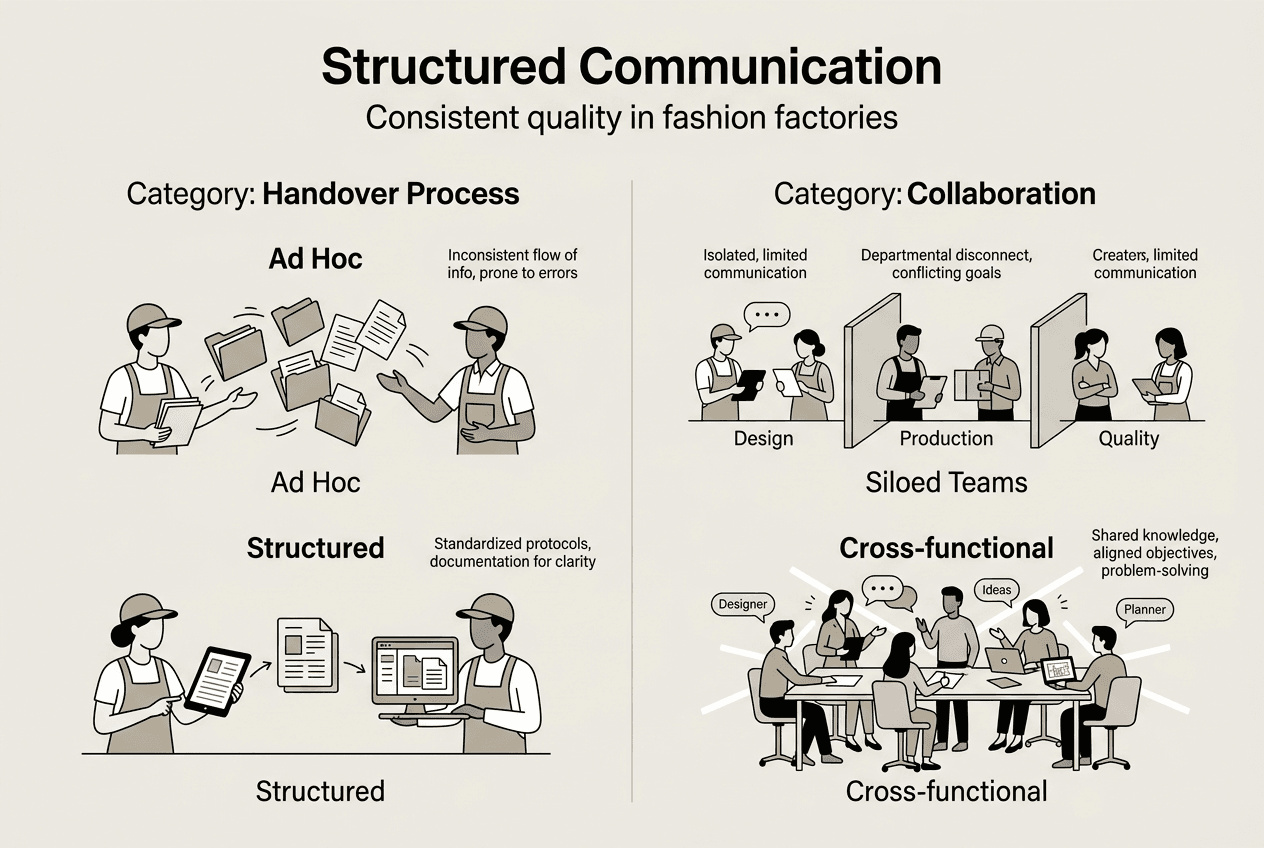
Structured digital handovers capture essential details systematically. Instead of relying on memory and judgment, your team follows a checklist that covers machine status, in-progress orders, quality alerts, material inventory, and outstanding issues. This approach ensures nothing falls through the cracks because the system prompts for every critical data point.
Cross-functional meetings break down silos and promote shared understanding across teams. When your design, sourcing, production, and QC teams meet weekly to review upcoming orders, current challenges, and lessons learned, you create a feedback loop that prevents repeated mistakes. Your pattern maker learns why certain construction methods cause QC failures. Your sourcing manager understands how fabric lead times impact production schedules. Your QC team shares defect trends that inform design decisions for the next collection.
Best practices include staying in contact with floor workers, feedback surveys, and weekly cross-functional meetings. Regular contact with the people doing the work reveals problems before they escalate. A quick daily walkthrough where you ask open-ended questions uncovers issues that never make it into formal reports.
Implementing these practices closes gaps and supports scalable quality control. As you grow from 500 units per month to 5,000, you can't rely on informal communication and personal relationships to maintain quality. You need structured workflows that function regardless of which individuals are on shift.
Pro Tip: Record your cross-functional meetings and store the recordings in your shared platform. New team members can review past discussions to understand recurring issues and proven solutions, accelerating their learning curve and reducing repeated questions.
Here's how structured practices compare to ad hoc approaches:
| Practice Area | Ad Hoc Approach | Structured Approach | Impact on Quality |
|---|---|---|---|
| Shift Handovers | Verbal summary, selective details | Digital checklist, complete documentation | 40% fewer repeated issues |
| Cross-Functional Meetings | Irregular, agenda-free discussions | Weekly scheduled, documented action items | 30% faster problem resolution |
| Floor Worker Feedback | Manager intuition, occasional conversations | Regular surveys, open-door policy | 25% more early defect detection |
These practices work at any scale, but they become essential as you expand operations. A clothing factory guide for startups scaling in 2026 must prioritize communication infrastructure from day one, because retrofitting systems after chaos takes hold costs far more than building them correctly initially.
Understanding the role of a production partner in scaling fashion brands includes recognizing that systematic communication isn't optional. It's the foundation that supports every other quality control measure you implement.
Scaling communication across multi-plant and global fashion supply chains
Global fashion manufacturing faces amplified communication challenges due to dispersed teams and data silos. When your design team operates in Los Angeles, your fabric mill runs in Turkey, your cut and sew factory sits in Vietnam, and your finishing facility is in China, you're managing time zones, languages, and disconnected systems simultaneously. Each location maintains its own records, uses different software, and reports through separate channels.
Fragmented systems limit cross-plant visibility and slow problem resolution. When your Vietnam factory discovers a fabric defect, they email your LA office, who then contacts your Turkish mill, who investigates and responds days later. Meanwhile, production continues with defective material because no one has real-time visibility into the issue or authority to halt the line immediately.
Unified digital platforms using IIoT create real-time accessible data across locations. Industrial Internet of Things sensors and cloud-based dashboards connect your entire supply chain, giving every stakeholder instant access to production status, quality metrics, inventory levels, and issue alerts. When your Vietnam QC inspector flags a defect, your LA manager, Turkish mill contact, and Vietnam production lead all see the alert simultaneously and can coordinate the response in real time.
These platforms enable faster collaboration, data-driven decisions, and more agile quality control. Instead of waiting for weekly reports to understand production trends, you monitor live dashboards that show defect rates, throughput, and material usage across all facilities. This visibility lets you spot patterns early, allocate resources dynamically, and implement corrective actions before small problems become expensive crises.
LA clothing manufacturers scaling quality control in 2026 must invest in unified platforms that support global coordination. The alternative is managing supply chains through email, spreadsheets, and phone calls, an approach that breaks down completely once you exceed a handful of production partners.
Here's how fragmented versus unified communication approaches compare in global supply chains:
| Communication Aspect | Fragmented Systems | Unified Platform | Business Impact |
|---|---|---|---|
| Defect Visibility | Delayed email reports, siloed data | Real-time alerts, shared dashboards | 50% faster issue resolution |
| Cross-Location Collaboration | Asynchronous messages, version confusion | Synchronized data, instant coordination | 35% reduction in miscommunication costs |
| Decision-Making Speed | Wait for reports, manual data aggregation | Live analytics, automated insights | 45% faster response to production changes |
| Supplier Management | Separate assessments per location | Unified supplier scorecards | 30% better supplier performance tracking |
The investment in unified platforms pays for itself through reduced rework, faster problem resolution, and improved supplier accountability. More importantly, it creates the communication infrastructure needed to scale beyond your current production volume without proportionally increasing coordination overhead.
Streamline your apparel production communication with Protek & Friends
Protek & Friends specializes in systematic clothing production services that eliminate the communication chaos plaguing fashion brands scaling in 2026. We blend USA oversight with strategic overseas manufacturing, giving you the quality control of domestic production with the cost efficiency of global sourcing.
Our full-package production process prioritizes transparent communication and integrated quality control across every stage, from initial design review through final delivery coordination. We document everything before you pay, provide structured handovers between development and bulk production, and maintain real-time visibility into your order status. No guessing, no surprises, no expensive miscommunications that blow up your margins. Contact Protek & Friends to access expert production workflows and digital tools that turn communication from a liability into your competitive advantage.
Frequently asked questions about communication in manufacturing
How do I reduce communication errors during shift changes?
Implement structured digital handovers using checklists that cover machine status, in-progress orders, quality alerts, and outstanding issues. Record handover meetings so the incoming shift can review details they might have missed during the live transition.
What digital tools best improve communication in apparel manufacturing?
Unified platforms that consolidate QC inspections, corrective actions, and supplier assessments into real-time dashboards deliver the highest ROI. Start with the tool that solves your biggest communication pain point, prove the value, then expand to additional systems.
How can self-managed teams benefit fashion production quality?
Self-managed teams communicate more frequently and with higher quality than hierarchical structures, reducing coordination overhead and catching defects earlier. Teams with clear ownership share information proactively instead of waiting for management directives, accelerating problem resolution.
What are practical ways to break down silos in multi-team manufacturing?
Schedule weekly cross-functional meetings where design, sourcing, production, and QC teams review upcoming orders and current challenges. Create shared digital platforms where all teams access the same real-time data, eliminating version control issues and information hoarding.
How important is communication frequency versus quality in production teams?
Quality matters more than frequency because precise, actionable information prevents errors, while frequent but vague updates create noise without value. Focus on structured communication that captures essential details systematically, then increase frequency only for high-stakes handoffs like shift changes or critical quality issues. Learn more about managing clothing production effectively.