
Scaling fashion production doesn't mean losing control. Many brand owners assume growth requires compromise, but structured process systems actually protect quality while increasing output. These systematic workflows transform chaotic manufacturing into predictable, margin-safe production that eliminates anxiety and delivers consistent results every time.
Table of Contents
- Introduction to process systems in fashion production
- How process design ensures product quality and fit consistency
- The efficiency and quality impact of structured process systems
- How transparency and communication improve production reliability
- Advantages and challenges of hybrid manufacturing models
- Production partner model vs traditional factory approach
- Common misconceptions and production pitfalls in fashion scaling
- Implementing process systems to scale your fashion brand
- Scale your fashion production with expert partners
- Frequently asked questions
Key takeaways
| Point | Details |
|---|---|
| Process systems enable scalable production | Structured workflows and communication protocols guide brands from concept to finished product with predictability. |
| Quality control integration reduces defects | Integrated checkpoints cut defects by 30% and minimize costly returns. |
| Transparent documentation protects margins | Brands using detailed specs report 90% higher confidence in cost projections and fewer surprises. |
| Hybrid models balance cost and quality | Combining local and overseas manufacturing requires systematic oversight to maintain consistency. |
| Partner approach outperforms factory orders | Collaborative production models deliver better communication, quality, and timeline reliability than traditional approaches. |
Introduction to process systems in fashion production
Process systems are the structured procedures, tech packs, communication protocols, and quality controls that transform creative concepts into scalable production. They replace guesswork with documentation. Fashion manufacturing evolved from artisanal workshops where a single craftsperson controlled every detail to systematized production capable of handling hundreds or thousands of units. This shift enabled brands to scale without sacrificing quality or bleeding money on preventable mistakes.
Scalable process systems matter because they directly protect your margins and reputation. Without them, you face disorganized workflows where nobody knows who approved what. Costs shift mid-production because fabric quantities weren't confirmed upfront. Timelines slide because communication happens through scattered text messages instead of structured updates. Quality suffers because there's no checkpoint between sample approval and bulk production.
Structured systems solve these problems by creating clarity at every stage:
- Design specifications documented in detailed tech packs before production starts
- Fabric sourcing tracked with confirmed quantities and delivery dates
- Sample evaluation with documented fit corrections and approval criteria
- Production milestones with regular updates and quality checkpoints
- Delivery coordination with transparent timelines and contingency plans
Brands using structured documentation report 90% higher confidence in cost projections and fewer unplanned expenses. That confidence translates directly to protected margins and reduced anxiety. When you know exactly what you're paying for and when it arrives, you can plan inventory, marketing, and cash flow accurately.
The difference between chaotic production and systematic production isn't complexity. It's control. Process systems don't add unnecessary steps. They eliminate the expensive mistakes that come from unclear expectations. Managing clothing production becomes predictable when everyone follows the same documented workflow. The role of sampling in fashion production shifts from guessing to validating before you commit to bulk orders. This fashion production process guide shows how systematized workflows create scalable quality.
How process design ensures product quality and fit consistency
Tech packs translate creative vision into manufacturing reality. These detailed specification documents include measurements, construction methods, materials, colorways, and finishing details. Without them, your factory interprets your design based on assumptions. With them, everyone works from the same blueprint. Tech packs prevent the costly scenario where your sample looks perfect but bulk production arrives with different stitching, fabric weight, or proportions.

Sample production validates your tech pack before committing to hundreds or thousands of units. You produce a small batch, evaluate fit and construction, document necessary corrections, and approve a final sample. This iterative process catches errors when fixing them costs $200 instead of $20,000. Fit corrections happen through structured feedback: measure the sample, compare to tech pack specs, identify discrepancies, update documentation, produce revised sample.
Communication channels between brand and manufacturer determine whether your design intent survives production. Clear channels mean your factory asks questions before making assumptions. Structured check-ins mean you catch problems at the fabric sourcing stage, not after cutting 500 garments. Regular photo updates with measurements confirm progress matches expectations.
Pro Tip: Invest extra time perfecting your tech pack details before sampling begins. Specifying exact stitch types, seam allowances, and finishing methods upfront reduces sample revisions by 40% and prevents expensive miscommunication during bulk production.
These design phase steps ensure consistency across your entire production run. When tech packs specify every detail and samples validate those specs, your 500th unit matches your 5th unit. Structured apparel production workflow prevents the common problem where early production looks great but quality drifts as workers rush later batches. Knitwear production clarity becomes especially critical given the technical complexity of knit construction and gauge specifications.
The efficiency and quality impact of structured process systems
Manufacturers implementing structured workflows report up to 30% reduction in lead times and 25% fewer quality defects. These aren't marginal improvements. They represent the difference between profitable production and margin erosion. Structured workflows eliminate wasted time searching for specifications, waiting for approvals, or fixing preventable errors.
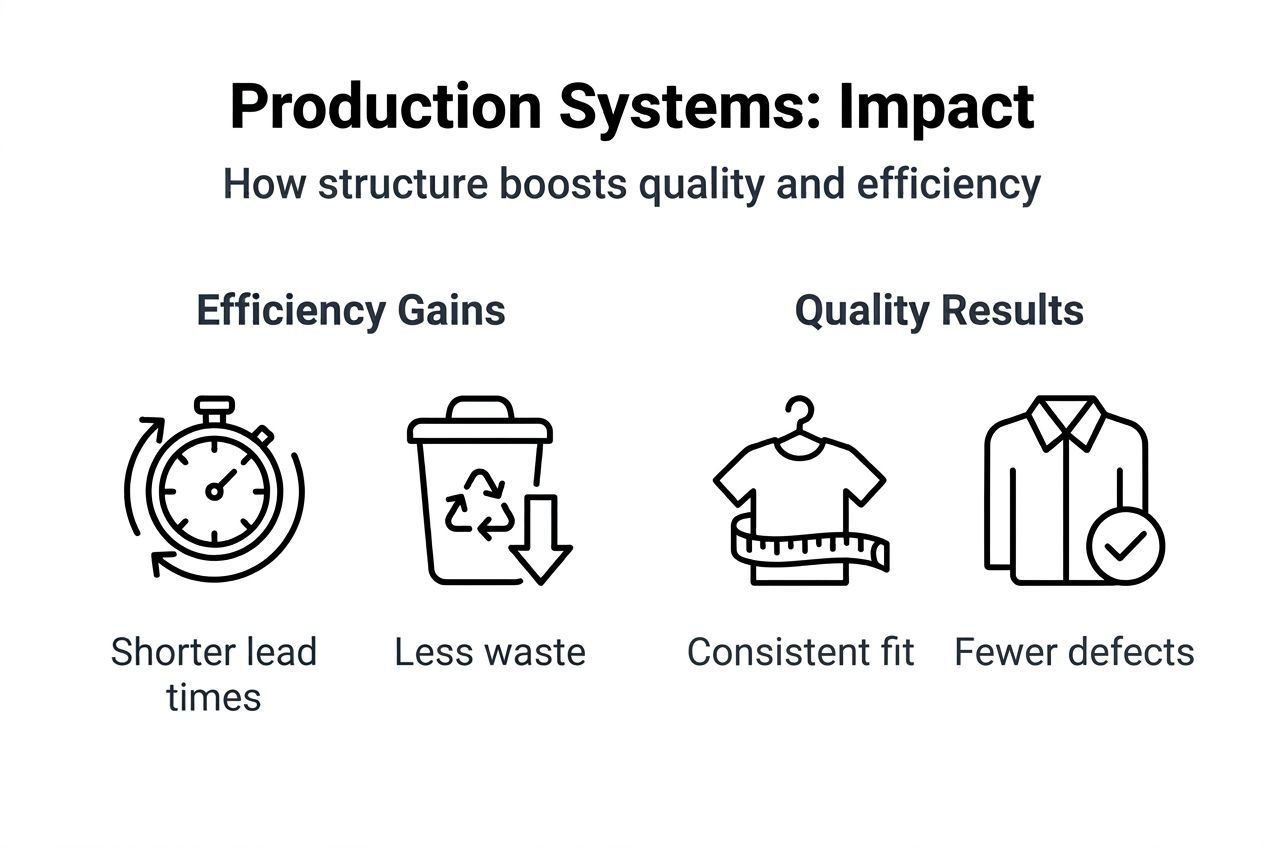
Quality control checkpoints at sampling and production phases prevent defects from reaching customers. Integrated checkpoints reduce product defects by 30% and returns by 15%. First checkpoint: sample approval with documented fit and construction validation. Second checkpoint: first article inspection after bulk cutting begins. Third checkpoint: inline inspection during production. Fourth checkpoint: final inspection before shipping. Each checkpoint catches specific error types before they multiply.
| Metric | Before System Implementation | After System Implementation |
|---|---|---|
| Average lead time | 90 days | 63 days |
| Quality defect rate | 8% | 5.6% |
| On-time delivery | 65% | 88% |
| Cost variance | 18% | 7% |
| Customer return rate | 6% | 3.9% |
Pro Tip: Track defect types and frequency at each checkpoint to identify recurring problems. If inline inspection repeatedly catches thread tension issues, address root causes with factory training rather than just fixing individual garments.
Operational efficiency gains compound over time. Reducing lead times by 30% means faster inventory turns and less capital tied up in production. Cutting defects by 25% lowers rework costs and preserves customer relationships. Better on-time delivery enables reliable launch dates and marketing commitments. Apparel production sampling becomes a strategic advantage when systematic processes catch issues early. Fashion production oversight reduces defects by creating accountability at every production stage. Learn more about fashion automation and efficiency and how to streamline fashion production process systematically.
How transparency and communication improve production reliability
Documentation before payment eliminates the biggest source of production anxiety: financial surprises. When your manufacturer provides detailed cost breakdowns covering fabric, trims, labor, and logistics before you commit, you know exactly what you're paying. No hidden fees. No unexpected upcharges because the factory underestimated fabric consumption. This transparency lets you price products accurately and protect margins from erosion.
Real-time update systems replace the black box of traditional manufacturing. Instead of placing an order and hoping for the best, you receive structured progress reports at key milestones. Fabric arrives and gets inspected: you get photos and confirmation. Cutting begins: you see first article photos. Production reaches 50%: you receive update on timeline and quality. These regular touchpoints prevent small problems from becoming shipment disasters.
Feedback loops enable quick issue resolution before they cascade. When your factory spots a fabric flaw during inspection, immediate notification lets you approve an alternative or adjust the design. When production reveals a construction challenge, early communication allows collaborative problem solving. Quick adjustments cost less and preserve timelines.
Brands using structured documentation report 90% higher confidence in cost projections and fewer unplanned expenses. Benefits include reduced cost variance, improved timeline adherence, and stronger manufacturer relationships built on mutual trust and clear expectations.
Communication best practices for brand to manufacturer interactions:
- Establish single point of contact on both sides to prevent mixed messages
- Schedule regular check-ins at predetermined milestones rather than ad hoc updates
- Document all approvals and changes in writing with dated confirmation
- Use shared photo libraries and measurement tracking for objective validation
- Create escalation procedures for handling urgent issues or timeline risks
- Maintain respectful, professional tone even when addressing problems
Clothing production services that prioritize transparent communication deliver more reliable outcomes. The production workflow protects margins by eliminating guesswork and establishing accountability. Industry resources on fashion production cost control emphasize documentation as the foundation of financial predictability.
Advantages and challenges of hybrid manufacturing models
Hybrid manufacturing combines domestic and overseas production to balance cost, quality, and lead time. You might produce core basics overseas for better unit economics while making limited edition pieces locally for faster turnaround and tighter quality control. Or source complex technical garments domestically where expertise lives while producing simpler items internationally.
| Factor | Local Production | Overseas Production |
|---|---|---|
| Unit cost | Higher (2x to 3x) | Lower |
| Lead time | 4-8 weeks | 8-16 weeks |
| Quality control ease | Easier (facility visits, direct oversight) | Harder (distance, time zones) |
| Communication | Real-time, same language/culture | Requires structured protocols |
| Minimum order quantities | Lower (50-200 units) | Higher (300-1000 units) |
| Shipping costs | Minimal | Significant |
| Flexibility for changes | Higher | Lower |
| Risk factors | Labor costs, capacity limits | Quality variance, customs, logistics |
Process complexity increases when coordinating multiple manufacturing locations. You need separate tech packs adapted to each factory's capabilities. Quality standards must remain consistent despite different production environments. Timeline coordination becomes critical when some components ship from Los Angeles while others arrive from Guangzhou. Inventory management grows more complex with multiple supply chains.
Process systems mitigate these challenges by standardizing documentation and communication across all manufacturing partners. The same tech pack format works for both domestic and overseas factories. Quality checkpoints follow identical procedures regardless of location. Regular updates maintain visibility into all production streams simultaneously.
Partner selection criteria for hybrid workflows include proven experience managing international logistics, demonstrated quality consistency across locations, and communication systems that work across time zones. Full package production fashion manufacturers with hybrid capabilities handle the coordination complexity so you maintain one relationship instead of juggling multiple factories.
Production partner model vs traditional factory approach
Traditional factory model treats production as transactional order fulfillment. You submit specs, the factory quotes a price, you place an order, and they produce. Communication happens reactively when problems arise. Transparency extends only to what you specifically ask about. The factory focuses on completing your order efficiently, not on your brand's success. Risks land squarely on you because the factory fulfilled the order as written, even if the outcome doesn't match your expectations.
Partner model treats production as collaborative problem solving. Your manufacturing partner reviews designs for producibility before quoting. They proactively identify potential issues during sampling. Communication happens through structured check-ins whether problems exist or not. Transparency includes sharing production schedules, quality metrics, and supply chain challenges. The partner focuses on your brand's growth because your success drives their business.
Benefits of the partner model:
- Improved on-time delivery through proactive timeline management and early problem flagging
- Better quality consistency via integrated oversight and continuous process improvement
- Risk reduction through shared responsibility and collaborative troubleshooting
- Margin protection from transparent pricing and early cost clarification
- Scalability support as partners invest in understanding your brand needs and growth trajectory
Key differences between approaches:
- Partners suggest design modifications to improve manufacturability; factories produce what you specify regardless of feasibility
- Partners maintain inventory visibility and coordinate logistics; factories ship when ready without considering your receiving capabilities
- Partners invest in relationship through dedicated account management; factories assign orders to available production managers
- Partners share industry knowledge and best practices; factories focus narrowly on order execution
Brand owners scaling production benefit from partnership approach because growth creates new challenges requiring collaborative solutions. Your first collection of 200 units uses different workflows than your fifth collection of 2,000 units. Partners adapt processes to support scaling. Traditional factories require you to figure out new systems independently. Compare protek manufacturer approaches to understand how partnership models deliver measurably better outcomes for growing brands.
Common misconceptions and production pitfalls in fashion scaling
Myth: Process systems overcomplicate production and slow everything down. Reality: Systems create clarity that speeds decision making and eliminates time wasted on confusion. You spend less time chasing updates or fixing miscommunication when everyone follows documented procedures. The upfront investment in creating tech packs and establishing protocols saves exponentially more time during production and prevents expensive errors.
Common pitfalls that cause costly mistakes and stress:
- Skipping tech pack detail to save time, then paying for multiple sample revisions because specs were unclear
- Inconsistent communication where some updates happen via email, others through texts, and decisions get lost
- Ignoring quality control milestones and discovering defects only at final inspection when fixing them is impossible
- Choosing manufacturers based solely on lowest price without evaluating their process capabilities or communication systems
- Assuming domestic production guarantees quality or overseas production means poor quality
- Underestimating lead times for fabric sourcing and treating production timeline as starting when you place the order
Hybrid manufacturing challenges that impact cost and quality when ignored include currency fluctuations affecting overseas pricing, customs delays creating timeline uncertainty, quality standard differences between domestic and international facilities, and coordination complexity when multiple factories produce components for the same collection. These aren't reasons to avoid hybrid models. They're factors requiring systematic management.
Pro Tip: Establish documentation and communication routines during your first small production run, even if it feels excessive for 100 units. These habits prevent catastrophic errors when you scale to 1,000 units and the stakes are ten times higher.
Understanding production realities prevents anxiety by replacing uncertainty with knowledge. You can't control fabric mills or shipping carriers, but you can control how thoroughly you document specifications and how consistently you communicate. Clothing line growth tips emphasize building systematic processes early to avoid painful lessons during scaling.
Implementing process systems to scale your fashion brand
Follow these steps to build scalable quality into your production:
-
Map and document every production stage clearly: design development, fabric sourcing, sample production, fit corrections, bulk production, quality control, and delivery coordination. Create written procedures for each stage specifying who does what and when.
-
Create detailed tech packs before sampling begins. Include technical sketches with callouts for construction details, full measurement specifications with tolerances, fabric and trim specifications with alternatives identified, colorways with Pantone references, and finishing requirements. Share these with your manufacturer for review and clarification.
-
Establish transparent communication protocols covering update frequency, preferred communication channels, approval procedures, and escalation paths for urgent issues. Schedule regular check-ins at predetermined milestones rather than waiting for problems.
-
Integrate quality control checkpoints at sample approval, first article inspection, inline production inspection, and final pre-shipment inspection. Document criteria for each checkpoint and assign responsibility for evaluation and approval.
-
Choose manufacturing partners experienced in hybrid models with demonstrated oversight capabilities across multiple production locations. Evaluate their communication systems, quality tracking procedures, and client references before committing.
Pro Tip: Review and update your process documentation after every production run. Note what worked well, what caused confusion, and what you would change. This continuous improvement approach builds increasingly efficient systems over time.
These steps reduce anxiety by creating predictability. You know what happens next because you documented the workflow. You protect margins because transparent pricing happens before production starts. You ensure scalable quality because checkpoints catch defects early. Brands using structured documentation report 90% higher confidence in cost projections and fewer unplanned expenses.
Implementation resources include this launch clothing line guide covering production planning and smart clothing line start tips emphasizing systematic approaches. Industry documentation on fashion production documentation importance reinforces how structured processes enable confident scaling.
Scale your fashion production with expert partners
Protek & Friends specializes in structured process systems that eliminate production anxiety for growing fashion brands. Based in Los Angeles with hybrid manufacturing capabilities across the USA and China, we manage the complexity so you maintain control. Our full-package approach covers design review, fabric sourcing, sampling, fit corrections, bulk production, quality control, and delivery coordination through transparent communication and documented procedures.
We operate as production partners, not order-taking factories. That means proactive problem solving before issues impact your timeline or budget. Structured documentation before you pay. Regular updates at every milestone. Quality checkpoints that catch defects when fixing them is still affordable. Experience across denim, knitwear, cut and sew, and specialty finishes.
Brand owners ready to scale with predictable quality and protected margins benefit from our systematic approach. Explore our clothing production services to see how we transform chaotic manufacturing into boring, reliable production. Learn what makes us different as a full package clothing manufacturer or compare protek manufacturers to understand the partnership advantage.
Frequently asked questions
What are process systems in fashion production?
Process systems are structured procedures, documentation protocols, and communication methods guiding fashion production from design through delivery. They ensure quality consistency, cost predictability, and scalability by replacing ad hoc workflows with systematic processes everyone follows.
How do process systems improve quality control during production?
Quality control checkpoints integrated at sampling and bulk production phases catch defects early when correction costs remain manageable. Process systems facilitate these checkpoints through documented evaluation criteria and structured communication, reducing rework expenses and customer returns significantly.
What challenges come with hybrid manufacturing models?
Hybrid manufacturing creates coordination complexity across multiple production locations with different capabilities, timelines, and quality standards. Communication across time zones and maintaining consistent quality require structured oversight. Process systems provide transparency and documented procedures to manage these challenges systematically.
What practical steps should brand owners take to implement process systems?
Map and document each production stage with clear procedures. Create detailed tech packs before sampling begins. Establish transparent communication protocols with regular milestone updates. Integrate quality control checkpoints at sample approval, first article, inline, and final inspection. Choose manufacturing partners experienced in systematic production management and hybrid models.