TL;DR:
- Small brands should select factory types based on their production stage, from print-on-demand to full-scale manufacturing.
- Evaluating factories should focus on quality standards, communication, QC protocols, and clear documentation.
- Structured workflows and documented processes are essential for scaling confidently and protecting brand reputation.
Not every factory is built for your brand. That's a hard truth many small fashion brand owners learn after a costly first production run. You place an order, timelines shift, quality misses the mark, and communication goes quiet. The assumption that any manufacturer can handle your vision is one of the most expensive mistakes in this industry. This article walks you through the main types of clothing production partners, how to evaluate them properly, and the step-by-step process that keeps your brand protected from concept to delivery. If you're ready to scale with structure instead of stress, this is where to start.
Table of Contents
- Understanding the types of clothing production partners
- Key criteria for evaluating a clothing production factory
- The step-by-step process: From design to delivery
- How to avoid common mistakes and scale with confidence
- Why small brands should embrace structure before scale
- Ready to scale? Partner with proven experts
- Frequently asked questions
Key Takeaways
| Point | Details |
|---|---|
| Match factory to brand stage | Use POD for testing and transition to small-batch or full factories as you scale for better control and margins. |
| Evaluate beyond price | Reliability, quality standards, and transparent processes matter more than upfront cost alone. |
| Demand structure and clarity | Request clear timelines, samples, and QC documentation to avoid production pitfalls. |
| Invest in relationships | Long-term success comes from nurturing a strong factory partnership, not switching for small savings. |
Understanding the types of clothing production partners
Before you reach out to a single factory, you need to know what kind of partner you're actually looking for. The manufacturing landscape isn't one-size-fits-all, and the wrong match will cost you time, money, and momentum.
There are three main categories worth understanding:
- Print-on-demand (POD): No minimum order quantities, fast setup, and branded packaging options. Great for testing a concept or launching branded samples with low financial risk. However, POD factories offer no-MOQ, branded solutions for test runs but give you limited control over full design execution.
- Small-batch manufacturers: These are cut-and-sew operations that work with lower minimums, typically 50 to 300 units per style. They offer real design control and are a strong fit for brands ready to move past POD but not yet at scale.
- Full-scale traditional factories: Higher MOQs, lower cost per unit, and more production capacity. These work well once your designs are proven and your volume justifies the commitment.
Knowing when to graduate from one to the next is critical. POD is ideal for R&D and branded samples. Once you've validated demand and you're ready for real design control and better margins, it's time to explore no minimum manufacturers or small-batch partners. And when volume grows, scaling with small manufacturers becomes a structured path forward.
Here's a quick comparison to help you decide:
| Factor | POD | Small-batch | Full-scale factory |
|---|---|---|---|
| MOQ | None | 50 to 300 units | 300+ units |
| Design control | Limited | High | High |
| Cost per unit | High | Medium | Low |
| Branding options | Yes | Yes | Yes |
| Speed to market | Fast | Medium | Slower |
This factory guide for startups breaks down these options even further if you want to go deeper. The point is simple: match the partner type to your current stage, not your future ambitions.
Key criteria for evaluating a clothing production factory
Now that you know the basic factory types, here's how to systematically evaluate which partner meets your small brand's ambition. Price is rarely the right starting point. The brands that protect their margins long-term are the ones that evaluate factories on a broader set of criteria.
Here's what to look for:
- Quality standards: Does the factory have documented QC processes? Can they show you examples of finished goods?
- Capacity and MOQ: Can they actually handle your order size without deprioritizing your brand?
- Communication: Are responses clear, timely, and in writing? Verbal agreements are not agreements.
- Location: Domestic production offers faster turnaround and easier oversight. Overseas production can reduce cost but adds lead time and complexity.
- Sample process: A factory that rushes or skips sampling is a red flag. Every serious partner should have a clear pre-production sample step.
- QC protocols: Ask specifically how defects are caught, who is responsible, and what happens when something goes wrong.
"Structured production processes can cut costs up to 15% and reduce errors significantly, making process discipline a direct driver of margin protection."
Undervaluing QC and ignoring timelines are two of the most common and costly mistakes small brands make. A factory that can't clearly explain its quality process isn't ready to be your partner. Understanding production terminology before your first conversation also puts you in a stronger position to ask the right questions.
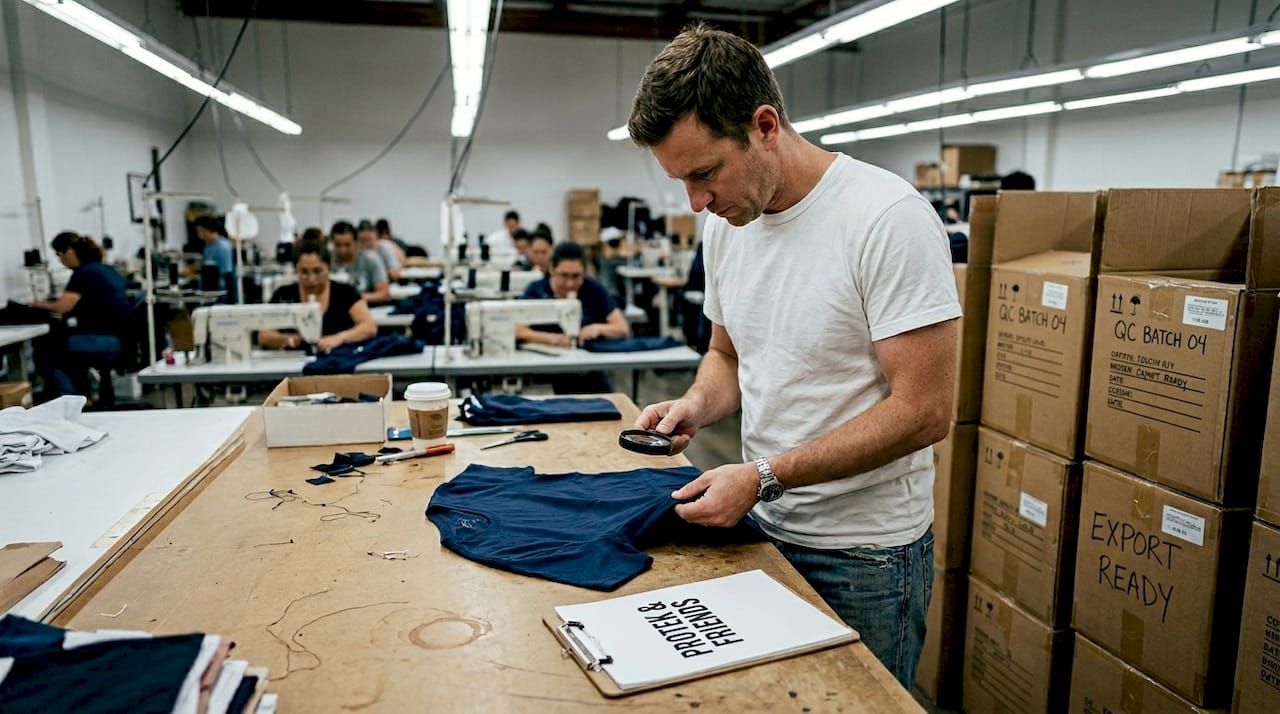
Pro Tip: Always request pre-production samples before placing a bulk order. Clarify QC protocols in writing before you pay a deposit. This one step alone prevents the majority of production disputes.
Structured workflows aren't just about efficiency. They're about protecting your reputation. A delayed or defective order doesn't just hurt your bottom line. It damages customer trust, which is far harder to rebuild than a production budget.
The step-by-step process: From design to delivery
Once you've shortlisted factories, knowing the standard workflow keeps your project on track and signals that you're a knowledgeable, serious partner. Factories respond differently to brands that understand the process versus those who don't. Knowing your milestones is part of your leverage.
Here are the core stages of a typical small brand production run:
- Design and tech pack: Finalize your design files, measurements, and construction details. A proper tech pack removes ambiguity before production starts.
- Fabric sourcing: The factory or production partner sources materials based on your spec. Confirm fabric content, weight, and color standards in writing.
- Pre-production sampling: A physical sample is made for your review. This is your chance to catch fit issues, construction problems, and material inconsistencies.
- Fit corrections and revisions: Revisions happen here, not during bulk. Every change at this stage saves money later.
- Bulk production: Once the sample is approved, bulk production begins. Clear timelines and check-in points should be agreed upon before this stage starts.
- Quality control: Inspections happen during and after production. Defect rates, measurements, and finishing are all reviewed.
- Shipping and delivery coordination: Final goods are packed, documented, and shipped. Logistics details should be confirmed well before this stage.
Effective production management improves reliability and on-time delivery across every one of these stages. Here's a sample timeline for a typical small brand order:
| Stage | Estimated time |
|---|---|
| Tech pack and design review | 1 to 2 weeks |
| Fabric sourcing | 1 to 3 weeks |
| Pre-production sampling | 2 to 4 weeks |
| Fit corrections | 1 to 2 weeks |
| Bulk production | 3 to 6 weeks |
| QC and shipping | 1 to 2 weeks |
Total lead time can range from 9 to 19 weeks depending on complexity and factory location. For brands working with apparel manufacturing companies that prioritize quality, this timeline is realistic and manageable.
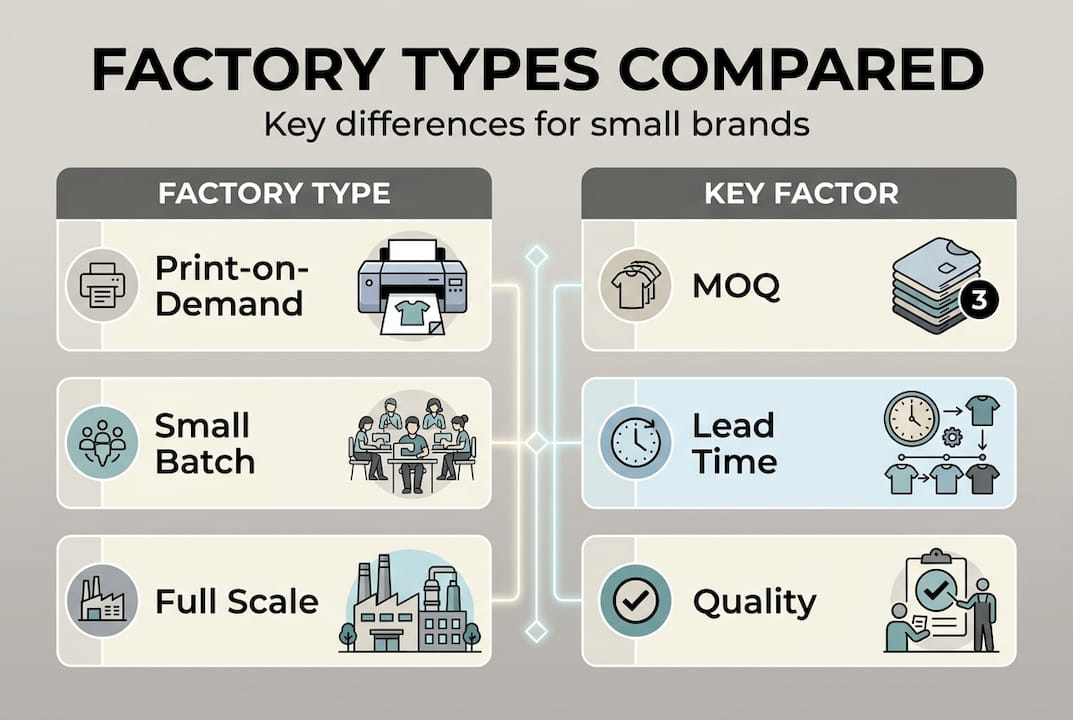
Pro Tip: Document every stage in writing. Approvals, change requests, and timeline confirmations should all be on record. This protects you if disputes arise and keeps everyone aligned.
How to avoid common mistakes and scale with confidence
Preparation is only half the battle. Here's how to avoid unnecessary headaches and set the foundation for sustainable growth. Even brands with solid designs and real demand lose money because of avoidable process failures.
The most common mistakes small brands make include:
- Skipping sampling: Jumping straight to bulk production to save time almost always costs more in the end.
- Unclear agreements: Verbal commitments don't hold up. Every term, timeline, and quality standard should be documented.
- Ignoring QC: Assuming a factory will catch its own mistakes without a formal QC process is a gamble you can't afford.
- Poor communication: Infrequent check-ins and unclear channels lead to surprises at delivery.
- Not vetting the factory: Checking references, reviewing past work, and understanding a factory's actual capacity takes time but saves far more.
Many small brands fail or lose margins due to skipped sampling, poor communication, or failing to secure clear agreements before production begins. These aren't rare exceptions. They're common patterns.
To mitigate risk, build a production checklist before every order. Revisit your terms when order sizes increase, because what worked at 100 units may not hold at 500. And invest in the relationship with your factory. Reliability is earned over time, and a factory that trusts you will prioritize your orders, flag problems early, and work with you when things get complicated.
Pro Tip: Document everything and revisit your production agreement before scaling to larger orders. A factory relationship built on clear expectations is one of your brand's most valuable assets.
The brands that scale well aren't the ones who found the cheapest factory. They're the ones who built a repeatable, documented process with a partner who communicates clearly.
Why small brands should embrace structure before scale
With the practical how-to's behind us, here's a deeper look at what actually leads to success for small and scaling apparel brands. Most brand owners I talk to are focused on cost and MOQs. That's understandable. But in my experience, the brands that struggle most aren't the ones with the smallest budgets. They're the ones who skipped structure in favor of speed.
Chasing the lowest price or the most flexible MOQ often leads to a partner who isn't equipped to grow with you. Print-on-demand can be a low-risk way to test your ideas but is no substitute for a factory partnership when scaling. POD gives you proof of concept. It doesn't give you a production system.
Real growth requires repeatability. That means clear specs, documented approvals, consistent QC, and a partner who communicates proactively. The benefits of structured production go beyond cost savings. They protect your reputation, your timeline, and your sanity.
The best brands I've seen scale aren't the ones with the most funding. They're the ones who treated production like a system, not a gamble. Structure before scale isn't a constraint. It's your competitive advantage.
Ready to scale? Partner with proven experts
You now have a clear picture of what it takes to choose the right production partner and run a successful manufacturing process. The next step is finding a partner who actually operates this way.
At Protek & Friends, we built our entire model around structure, clarity, and control. Our clothing production services are designed for small to mid-sized brands that are ready to produce correctly, not just quickly. We offer a hybrid manufacturing model with both U.S. and overseas options, MOQs tailored for growing brands, and a full-package production process that covers everything from tech pack review to delivery coordination. If you're ready to move from concept to finished product with zero surprises, let's talk.
Frequently asked questions
What is the minimum order quantity (MOQ) for small brand clothing factories?
MOQs vary widely, but many specialized factories and POD providers offer no-MOQ branded solutions, making them ideal for small brands starting out. As you scale, small-batch manufacturers typically start at 50 to 300 units per style.
How can I ensure product quality when working with a new factory?
Always request pre-production samples and clarify quality control steps before confirming an order. Structured processes and sampling cut errors and protect your margins from the start.
What are signs of a reliable clothing production factory?
Transparency, detailed communication, and a willingness to share previous work and documented processes are strong reliability indicators. Structured workflows help you verify and trust a manufacturing partner before committing.
Should I start with print-on-demand or a traditional factory?
POD is perfect for low-risk idea validation, but traditional factories are better when you're ready for higher volume and more design control. POD suits ultra-small tests but lacks the full cut-and-sew control of a true factory partnership.
How long does clothing production typically take for small brands?
Depending on factory type and complexity, production can take 2 to 12 weeks from final sample approval to delivery, with more complex orders running longer.
Recommended
- Small clothing manufacturers: scale your brand reliably
- Clothing factory guide for start-ups: scale smart in 2026
- How to choose an apparel factory in Los Angeles in 2026
- Find a sustainable clothing manufacturer: quality guide
- Sublimation printer buying checklist: essential 2026 guide – SubliBlanks Ltd