
Scaling your fashion brand should feel exciting, not exhausting. Yet most founders experience the opposite: more orders mean more chaos, longer hours firefighting problems, and constant anxiety about whether quality will hold. The surprising truth? This stress isn't inevitable. Scalable business systems reduce stress by creating predictability, reducing cognitive load, and enabling growth without chaos. Structure isn't the enemy of creativity or flexibility. It's the foundation that protects both while you scale.
Table of Contents
- Key Takeaways
- Understanding the stress challenges in scaling fashion production
- How structured production systems reduce operational stress
- Balancing structure and adaptability for resilient production
- Practical steps to implement structured production for less stress
- Streamline your fashion production with Protek & Friends
- Frequently asked questions
Key Takeaways
| Point | Details |
|---|---|
| Structure Builds Predictability | Structured production creates predictable steps, timelines, and responsibilities, reducing cognitive load and enabling scalable growth. |
| Centralized Tracking Cuts Chaos | A single source of truth for specs, timelines, and costs minimizes errors and stops information from getting lost in emails and spreadsheets. |
| Resilient Systems Beat Lean | A resilient production ecosystem handles uncertainty better than lean only approaches by sustaining quality and on time delivery during growth. |
| Gradual Lean Tool Rollout | Implementing lean tools gradually while centralizing tracking boosts efficiency by reducing disruption and enabling steady capacity gains. |
| Structured Workflows Reduce Firefighting | Documented workflows help scaling brands cut firefighting, maintain quality, and meet deadlines as SKUs expand. |
Understanding the stress challenges in scaling fashion production
When you move from producing 500 units per season to 2,000 or 5,000, everything changes. The same informal approach that worked for your first collections suddenly creates bottlenecks everywhere. You're juggling more fabric suppliers, tracking multiple production timelines, coordinating with different factories, and managing quality across expanding SKU counts.
Without predictable systems, every production cycle feels like starting from scratch. You're constantly clarifying specs that should be documented, chasing updates that should be automated, and fixing mistakes that structured workflows would prevent. This manual chaos doesn't just waste time. It drains your mental capacity for strategic decisions.
Cognitive overload becomes the silent killer of scaling brands. When you're firefighting daily crises, you can't focus on design innovation, market positioning, or customer experience. Your brain gets stuck in reactive mode, jumping from one urgent email to the next urgent phone call. This constant context switching exhausts founders faster than the actual workload.
The real danger? Unstructured processes directly threaten the two things that built your brand: quality and timely delivery. When managing clothing production relies on memory instead of documentation, mistakes multiply. A miscommunication about seam allowances becomes 1,000 defective units. A forgotten timeline update becomes a missed retail deadline.
Here's what stress looks like in unstructured scaling:
- Spending hours searching old emails for production specifications
- Discovering fabric shortages days before cutting should start
- Receiving samples that don't match your tech pack instructions
- Missing quality issues until bulk production is already complete
- Constantly renegotiating timelines because nothing was documented clearly
These aren't minor inconveniences. They're symptoms of a system that can't support your growth ambitions. Understanding these pain points is the first step toward building something better. Starting your clothing line with stress-free growth requires recognizing that structure isn't bureaucracy. It's the framework that makes scaling possible without sacrificing your sanity.
How structured production systems reduce operational stress
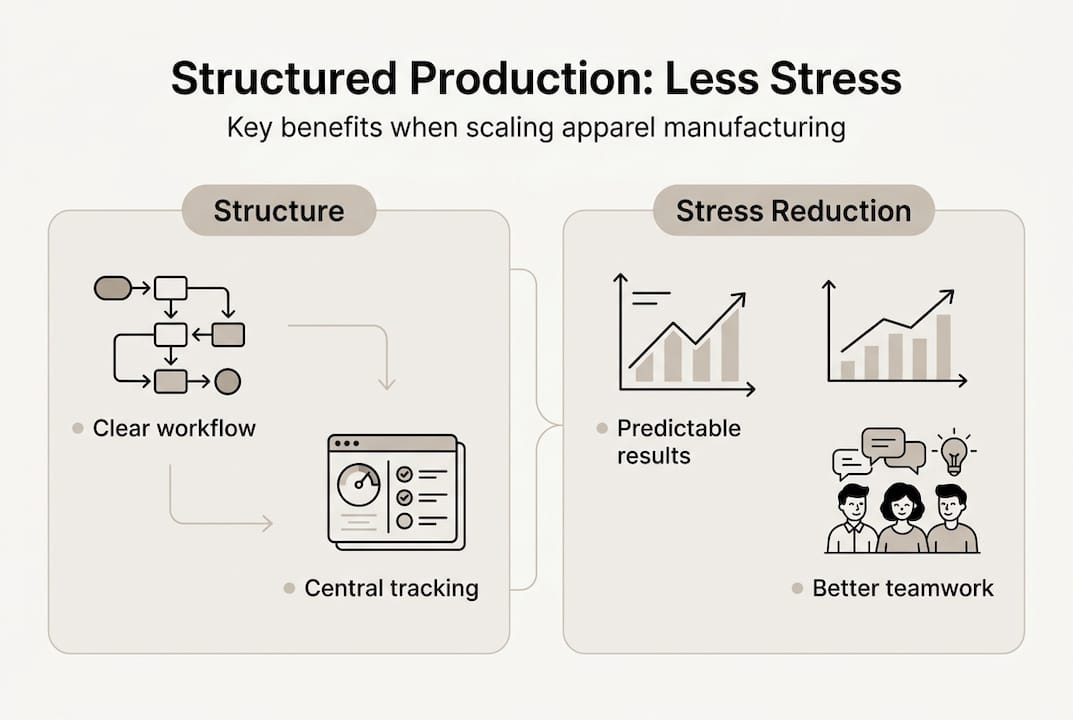
Predictability is the antidote to production anxiety. When you know exactly what happens at each stage, when it happens, and who's responsible, your brain stops burning energy on uncertainty. Structured workflows create this predictability by documenting every step from design approval through final inspection.

Centralized tracking systems eliminate the chaos of scattered information. Instead of hunting through email threads, spreadsheets, and chat messages, you have one source of truth. Every spec, every timeline, every cost breakdown lives in a single accessible system. This simple shift reduces manual errors dramatically because you're not relying on memory or outdated files.
The data backs this up. Research shows that ERP-MIS integration reduces lead times by 18%, improves resource utilization by 23%, and boosts order accuracy by 15%. These aren't marginal gains. They represent the difference between constantly firefighting and confidently scaling.
Here's what integrated systems deliver:
| System component | Stress reduction benefit |
|---|---|
| Centralized spec database | No more searching for correct measurements |
| Automated timeline tracking | Proactive alerts replace reactive scrambling |
| Digital approval workflows | Clear accountability, fewer miscommunications |
| Real-time inventory visibility | Prevent material shortages before they delay production |
| Quality checkpoint documentation | Catch issues early, not after bulk production |
When your production team knows exactly what's expected and when, communication stress drops significantly. Factory partners appreciate clear documentation because it eliminates guesswork. You appreciate it because you're not answering the same questions repeatedly or clarifying specs that should have been locked weeks ago.
Scalable systems grow with you without exponential complexity. Adding another style or another 1,000 units doesn't require reinventing your entire process. The structure absorbs growth because the workflows, templates, and tracking mechanisms already exist. You're duplicating proven systems, not creating new chaos.
Pro Tip: Start tracking your weekly hours spent on production firefighting versus strategic planning. Most founders are shocked to discover they spend 70% of their time reacting to preventable problems. Structured systems flip this ratio, giving you mental space for the work that actually grows your brand.
The psychological impact matters as much as the operational efficiency. When you trust your systems, you sleep better. You're not lying awake wondering if you forgot to confirm a fabric order or if the factory understood your grading instructions. Process systems for fashion production protect quality while reducing the mental load that burns out creative founders.
Better communication through scalable apparel manufacturing means fewer misunderstandings, faster problem resolution, and stronger factory relationships. When everyone works from the same documented information, collaboration replaces confusion.
Balancing structure and adaptability for resilient production
Lean production principles deliver efficiency, but efficiency alone won't protect you during disruptions. The pandemic proved this brutally. Brands with ultra-lean, just-in-time systems had no buffer when supply chains fractured. They couldn't pivot because their structures were optimized for predictability, not adaptability.
Viable production ecosystems emphasize resilience through stress-testing. This means deliberately probing your systems for vulnerabilities before crises expose them. What happens if your primary fabric supplier suddenly can't deliver? What if shipping costs double overnight? What if your factory partner loses capacity?
Structure and flexibility aren't opposites. They're partners. Strong frameworks give you the foundation to adapt quickly when circumstances change. Without documentation and centralized tracking, every disruption becomes an existential crisis because you're improvising solutions from scratch.
Deep uncertainty requires different thinking than normal operational challenges. When adapting production for unpredictable events, viability-focused structures outperform pure efficiency models. This means building in buffers, maintaining backup supplier relationships, and designing workflows that can flex without breaking.
Here's what resilient structure looks like:
- Documented backup suppliers for critical materials, not just primary vendors
- Flexible timeline buffers that absorb unexpected delays without missing retail deadlines
- Quality checkpoints at multiple stages, catching issues before they compound
- Clear decision-making protocols for common disruptions, eliminating panic reactions
- Regular system reviews that identify weak points before they cause problems
"In chaotic uncertainty, structured viable ecosystems via stress-testing enhance resilience over mere efficiency. The goal isn't just running lean. It's surviving and thriving when conditions shift unpredictably."
This approach reduces anxiety because you've already thought through contingencies. When a fabric shipment gets delayed, you're not scrambling. You're executing a pre-planned response. The structure holds while you adapt the specifics.
Gradual layering of lean tools enhances resilience without overwhelming your team. You don't need to implement every system simultaneously. Start with the highest-impact areas, prove the concept, then expand. This measured approach builds confidence and capability simultaneously.
Brands that switch manufacturers often do so because their previous partner couldn't balance efficiency with adaptability. They got stuck in rigid processes that couldn't accommodate reasonable changes or handle unexpected challenges gracefully.
The sweet spot is structured flexibility: clear processes that everyone understands, with built-in mechanisms for handling exceptions. This gives your team confidence to make smart decisions without constantly seeking approval, while maintaining the guardrails that protect quality and timelines.
Practical steps to implement structured production for less stress
Start simple with time and action calendars. These visual timelines map every task from design lock to final delivery, showing dependencies and deadlines clearly. When everyone sees the same calendar, accountability improves naturally. No one can claim they didn't know a deadline was approaching.
Implement centralized tracking for all production data immediately. This doesn't require expensive software initially. A well-organized shared drive with consistent file naming and clear folder structures beats scattered emails and local files. The key is single source of truth: one place where the current, correct information lives.
Use a phased approach to avoid overwhelming your team and factory partners. Trying to restructure everything simultaneously guarantees resistance and mistakes. Instead, pick one production cycle to pilot new systems. Learn what works, adjust what doesn't, then expand to other areas.
Here's a practical implementation sequence:
- Document your current process completely, including every handoff and decision point
- Identify the three biggest pain points causing stress or delays
- Design simple systems addressing those specific problems first
- Test new workflows on one style or small production run
- Gather feedback from everyone involved, refine the approach
- Roll out proven systems to full production gradually
- Monitor efficiency metrics and quality outcomes monthly
- Adjust and optimize based on real performance data
Pro Tip: Create production templates for recurring tasks like tech pack creation, sample approval, and pre-production meetings. Templates ensure nothing gets forgotten and dramatically reduce the mental load of starting each new cycle.
Benchmarks show 10-25% efficiency gains from lean tools and centralized tracking. These improvements translate directly into less firefighting and more strategic thinking time. You're not working harder. You're working smarter through better systems.
Regularly review quality and time margins to catch drift before it becomes crisis. Monthly production retrospectives help teams identify what worked, what didn't, and what needs adjustment. This continuous improvement mindset prevents complacency and keeps systems relevant as your brand evolves.
Here's how different approaches compare:
| Approach | Setup effort | Stress reduction | Scalability | Quality impact |
|---|---|---|---|---|
| No structure | None | None | Poor | Declining |
| Basic calendars | Low | Moderate | Fair | Stable |
| Centralized tracking | Medium | High | Good | Improving |
| Integrated ERP/MIS | High | Very high | Excellent | Optimized |
When working with clothing factories as you scale, structured communication becomes non-negotiable. Clear documentation protects both parties and builds trust. Your factory partner knows exactly what you expect. You know exactly what they committed to delivering.
Structured apparel production workflows protect margins by eliminating costly mistakes and rework. When specs are clear, samples are right the first time. When timelines are realistic and tracked, you avoid expensive rush fees. Structure isn't overhead. It's margin protection.
Streamline your fashion production with Protek & Friends
Building these systems yourself takes time you probably don't have. That's where experienced production partners make the difference.
Protek & Friends specializes in structured, transparent clothing production services designed specifically for scaling fashion brands. We've built the centralized systems, quality checkpoints, and clear communication workflows that eliminate production stress. Our hybrid model offers both Los Angeles and overseas manufacturing, giving you flexibility without sacrificing structure. We handle everything from design review through final delivery, with documentation at every stage. No surprises, no chaos, just dependable production that protects your quality and margins. Our clients spend less time firefighting and more time growing their brands because our systems do the heavy lifting. Whether you're wondering how many samples you need before committing to bulk or ready to scale with confidence, our Los Angeles full-package production team brings the structure that makes growth feel manageable instead of overwhelming.
Frequently asked questions
How quickly should I implement structured production systems?
Start immediately with simple tools like time and action calendars, but phase in comprehensive systems over 3-6 months. Rushing implementation creates more stress than it solves. Pick one production cycle to pilot new workflows, learn from it, then expand gradually.
What are common mistakes when adding structure to production?
The biggest mistake is over-engineering systems before understanding what actually causes stress. Start by documenting your current reality, identify the top three pain points, then build targeted solutions for those specific problems. Avoid implementing structure for structure's sake.
How does structure impact product quality during scaling?
Structure dramatically improves quality consistency by documenting specifications, creating checkpoint workflows, and ensuring everyone works from the same information. When LA clothing manufacturers scale quality control through structured systems, defect rates drop because mistakes get caught early instead of compounding through production.
Can too much structure increase stress?
Yes, if systems become bureaucratic obstacles rather than helpful frameworks. The goal is minimum viable structure: enough documentation and process to create predictability without slowing decisions. Regularly review whether each system adds value or just adds steps.
Are there tools recommended specifically for fashion production management?
Start with shared project management platforms like Asana or Monday for timeline tracking, combined with cloud storage for centralized documentation. As you scale, consider fashion-specific PLM systems. The tool matters less than consistent usage and team buy-in.
How does working with a production partner change the structure needed?
A strong production partner for scaling fashion brands should bring their own structured systems, reducing your internal burden. You still need clear specs and decision-making processes, but the partner handles workflow management, quality tracking, and factory coordination. This partnership model lets you focus on design and brand building while they manage production complexity.