TL;DR:
- Structured production processes and documentation are key to scaling US fashion brands effectively.
- Choosing the right partners involves evaluating experience, communication, minimums, and quality practices.
- Ongoing quality control and strong factory relationships are crucial for successful growth in US manufacturing.
Most emerging fashion brands hit the same wall. Timelines shift without warning, samples come back wrong three times in a row, and the factory stops responding mid-production. Nearly 60% of small fashion brands report that inconsistent production quality is their biggest barrier to scaling. That number is not surprising when you look at how most brands approach development: reactive, undocumented, and built on promises instead of systems. The good news is that structured production partnerships in the USA make predictability achievable. This article walks you through the full development process, how to choose the right partners, and how to lock in quality at every stage.
Table of Contents
- Understanding the fashion product development process in the USA
- Choosing the right production partners for scaling your brand
- Fabric sourcing and supply chain management in US product development
- Ensuring quality control and efficiency in American fashion manufacturing
- The surprising truth about scaling US fashion production
- How Protek & Friends empowers your brand
- Frequently asked questions
Key Takeaways
| Point | Details |
|---|---|
| Structured process | Following a defined development roadmap ensures predictable timelines and quality for your fashion brand. |
| Partner selection | Choosing the right manufacturing partner is crucial for scaling efficiently and avoiding costly setbacks. |
| Fabric sourcing | Domestic sourcing reduces risk, speeds up production, and lowers returns for US-based brands. |
| Quality assurance | Built-in quality control and communication prevent errors and keep production on schedule. |
Understanding the fashion product development process in the USA
Before you can scale, you need a clear picture of what development actually looks like from start to finish. A lot of brand owners jump into production without understanding the full roadmap, and that is where costly mistakes happen. Step-by-step development in US manufacturing facilities follows a defined sequence that protects your timeline and budget when followed correctly.
Here is how the process typically unfolds:
- Design and technical review. Your concept gets translated into a tech pack with measurements, construction details, and material specs. This document drives every decision downstream.
- Prototyping. A first physical version is built to test construction and silhouette. This is not the final sample. It is a test.
- Sampling and fit correction. The proto gets refined into a fit sample. You review, mark corrections, and the factory revises. This cycle can take two to four rounds depending on complexity.
- Pre-production sample. This is the approved version that bulk production must match. It is your quality benchmark.
- Mass production. Bulk cutting, sewing, finishing, and QC checks happen here. Timeline depends on order size and factory capacity.
- Delivery and final inspection. Finished goods are inspected before shipping. Any issues caught here are far cheaper to fix than after delivery.
Typical timelines range from 12 to 20 weeks for a full development cycle, depending on fabric sourcing lead times and revision rounds. Brands that skip steps or rush sampling almost always pay for it in bulk production errors.
"The sample is not a formality. It is your contract with the factory about what bulk should look like."
When you approach full package production correctly, every stage feeds the next with clear documentation. That is what separates brands that scale cleanly from brands that restart from scratch every season. Understanding scaling USA production means respecting the process, not rushing it.
Choosing the right production partners for scaling your brand
With a blueprint of the process, it is crucial to find the right partners. Not all factories are built the same, and choosing the wrong one costs you more than money. It costs you time, trust, and sometimes your entire season.
The two most common factory types you will encounter are cut and sew and private label manufacturers. Overview of cut and sew production methods in US-based manufacturing shows that cut and sew facilities build garments from raw fabric according to your specs. Private label manufacturers offer pre-existing base styles you can customize. Each has a place depending on your product category and how much design control you need.
| Factor | Cut and sew | Private label |
|---|---|---|
| Design control | High | Limited |
| Minimum order qty | Higher | Lower |
| Lead time | Longer | Shorter |
| Best for | Custom collections | Basics and staples |
| Cost per unit | Higher | Lower |
When vetting any production partner, look at these key criteria:
- Experience in your category. A factory that specializes in denim is not automatically great at knitwear.
- Communication speed and clarity. If they are slow to respond before you sign, they will be slower after.
- Minimum order quantities. Make sure their MOQs align with your current volume, not your projected volume.
- Sample quality track record. Ask for references or examples from past clients.
- Documentation practices. Do they use tech packs, production schedules, and written approvals?
Pro Tip: Always request a sample order before committing to bulk. A factory that refuses or discourages this is a red flag. You need proof of capability, not just a portfolio.
For deeper guidance on finding reliable manufacturers in the USA, look beyond price and location. Systems and communication matter just as much. Explore private label tools and scaling with quality to build a shortlist that fits your brand's actual stage of growth.
Fabric sourcing and supply chain management in US product development
Once you have your production partners, managing materials and supply chain is your next priority. Fabric is not just a material decision. It is a timeline decision, a quality decision, and a cost decision all at once.
US-based brands have two main sourcing paths: domestic and import. Each comes with real tradeoffs.
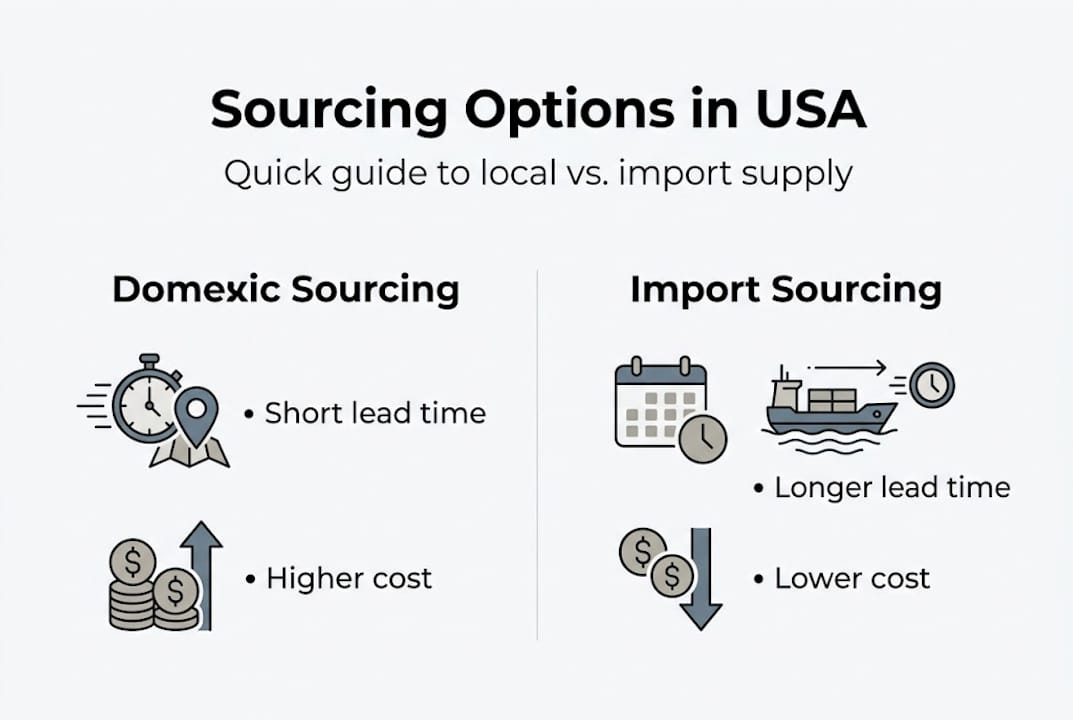
| Sourcing type | Lead time | Cost | MOQ | Risk level |
|---|---|---|---|---|
| Domestic (USA) | 2 to 4 weeks | Higher | Lower | Low |
| Import (Asia/Europe) | 8 to 16 weeks | Lower | Higher | Medium to high |
Structured fabric sourcing reduces returns by up to 40%, which is a significant margin protection strategy for any brand. That number reflects what happens when fabric specs are documented, tested, and approved before bulk cutting begins.
Here is what a structured sourcing approach looks like in practice:
- Request fabric swatches and spec sheets before approving any material.
- Run shrink and dye tests on all fabrics before cutting bulk.
- Confirm lead times in writing so your production schedule accounts for real delivery windows.
- Keep a backup supplier for core fabrics to avoid full shutdowns when a supplier has delays.
- Track inventory by SKU to avoid over-ordering or running short mid-production.
For brands working with Los Angeles production services, domestic sourcing is often the smarter starting point. Shorter lead times mean fewer surprises. As volume grows, a blended strategy using domestic for speed and import for cost efficiency gives you the most flexibility. Read more about fabric sourcing clarity to build a sourcing plan that actually holds up under production pressure.
Ensuring quality control and efficiency in American fashion manufacturing
With sourcing locked in, quality and efficiency become the focus. This is where many brands lose control because they treat QC as a final step rather than an ongoing process built into every stage.
End-to-end process of developing fashion products in U.S. manufacturing shows that brands with structured QA checkpoints at multiple stages have significantly fewer bulk rejections and returns. Here is how to build that structure:
- Pre-production meeting. Align with your factory on specs, timeline, and quality benchmarks before cutting begins.
- In-line inspection. Check a percentage of units during production, not just at the end. Catching a stitch error on unit 50 is far better than unit 500.
- Mid-production review. Pull a sample batch at the 30 to 40 percent completion mark. Confirm construction, measurements, and finishing match your pre-production sample.
- Final QC inspection. Inspect finished goods against your approved sample before packaging. Use an AQL standard to set your acceptable defect rate.
- Delivery verification. Confirm quantities, labeling, and packing accuracy before goods ship.
"Quality control is not about catching problems. It is about building a process where problems have fewer places to hide."
Pro Tip: Create a simple QC checklist document for every style. Share it with your factory before production starts. When everyone is checking against the same list, you eliminate a huge percentage of miscommunication errors.
For more detail on the sample development guide and how it connects to QC, review your approval process before every bulk run. Efficiency comes from clear communication and early problem solving, not from rushing.
The surprising truth about scaling US fashion production
Here is what most guides will not tell you: the biggest reason brands fail to scale is not cost. It is culture. Specifically, the culture of the partnership between a brand and its production team.
I have seen brands choose overseas factories purely on price, only to spend three times their savings on corrections, reshipping, and delayed launches. The math rarely works out the way the spreadsheet promises. US-based production, especially when structured through a full package model, often delivers better total value when you factor in communication speed, revision turnaround, and accountability.
The brands that scale successfully share one trait: they treat production as a relationship, not a transaction. They invest in documentation, show up prepared, and choose partners who operate with the same level of seriousness. Price matters. But partnership culture matters more than most people admit until they have lost a season to a factory that simply stopped communicating. Structure is not a luxury. It is the foundation everything else is built on.
How Protek & Friends empowers your brand
If you have read this far, you already understand that scaling a fashion brand requires more than a factory. It requires a system.
At Protek & Friends, we built our entire model around giving brand owners exactly that. From technical review and fabric sourcing to fit corrections, bulk production, and final QC, every step is documented and communicated clearly. No guessing. No chasing updates. Our clothing production services are designed for brands that are ready to produce correctly, protect their margins, and grow with confidence. If you are ready to replace production stress with a process that actually works, let's talk.
Frequently asked questions
What are the main stages of fashion product development in the USA?
The process typically includes design, prototyping, sampling, mass production, and delivery, with quality checks built into each phase. Following this step-by-step development sequence protects your timeline and reduces costly revisions during bulk.
How do I find reliable clothing manufacturers in the USA?
Evaluate manufacturers based on production capacity, communication practices, minimums, and verified references from other brand owners. A detailed guide on finding reliable clothing manufacturers can help you build a vetting checklist that goes beyond price.
What are the advantages of sourcing fabrics domestically for US brands?
Domestic sourcing offers shorter lead times, lower logistics risk, and easier quality verification before bulk cutting begins. For a full breakdown, fabric sourcing explained covers how to structure your sourcing strategy for consistent results.
How does quality control work in US-based apparel manufacturing?
Brands use defined QA checkpoints at pre-production, in-line, and final inspection stages to catch issues early and maintain standards. Structured USA clothing production systems make this process repeatable across every order.