TL;DR:
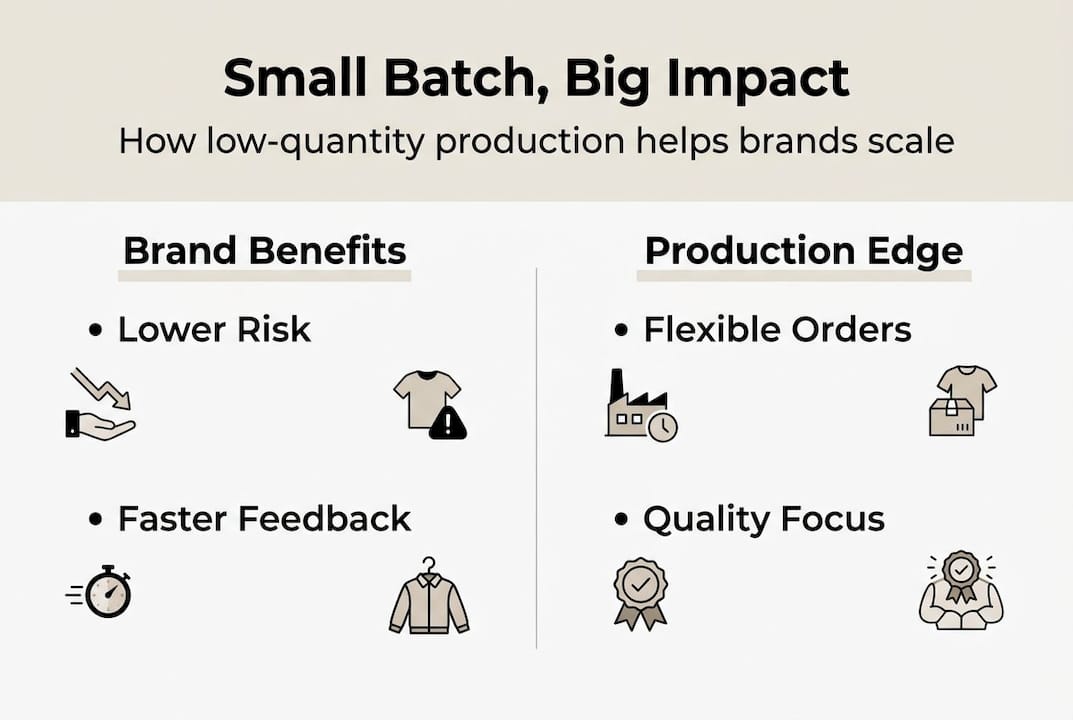
- Small batch manufacturing involves low minimum order quantities to reduce inventory risk and increase flexibility.
- It is ideal for testing new styles, markets, or trends with faster lead times and quicker feedback.
- Building strong relationships with manufacturers enhances quality, problem-solving, and long-term growth.
Most first production runs fail quietly. You place a large order, wait months, and then sit on inventory that never moves. 73% of 500+ unit first runs still have unsold stock after 12 months. That is not a cash flow problem. That is a strategy problem. Small units clothing manufacturers exist to fix exactly this. They give brands a smarter entry point, a way to test, learn, and grow without betting everything on one large run. This guide breaks down what small units manufacturing actually means, when it makes sense, and how to use it to scale your brand with less risk and more control.
Table of Contents
- What is a small units clothing manufacturer?
- When and why to choose small batch over large scale production
- Risks, quality control, and common pitfalls with small units production
- How to work successfully with a small units clothing manufacturer
- The truth most brands miss about small units manufacturing
- Scale your brand with expert small batch manufacturing support
- Frequently asked questions
Key Takeaways
| Point | Details |
|---|---|
| Lower inventory risk | Small batch manufacturing lets you test trends and adjust quickly, reducing unsold inventory. |
| Faster time to profit | Launching with 50-100 units often delivers profitability 40 percent faster than large production runs. |
| Quality matters more | Defects or poor fit have bigger consequences when producing smaller quantities, so clear systems are vital. |
| Culture of communication | Close manufacturer relationships and transparent routines ensure high quality and reliable growth. |
What is a small units clothing manufacturer?
A small units clothing manufacturer is a production partner that specializes in low minimum order quantities, commonly called MOQs. Instead of requiring 500 or 1,000 pieces per style to start a run, these manufacturers work with brands at a much earlier stage. MOQs as low as 25 to 100 units per style are standard among reputable small batch producers in the US.
This model exists because not every brand is ready to commit to large volumes. New collections need real market feedback. Trending styles move fast. And cash flow is almost always tighter than founders expect. Small units manufacturers are built around these realities.
The two strongest hubs for this type of production in the US are Los Angeles and New York City. The LA Fashion District and the NYC Garment District both have dense networks of small batch factories, fabric suppliers, and trim vendors within close proximity. This concentration makes communication faster and sampling turnarounds shorter. Working with quality LA clothing manufacturers gives you access to that ecosystem directly.
Here is how small units manufacturers compare to traditional large-scale factories:
| Factor | Small units manufacturer | Traditional manufacturer |
|---|---|---|
| Minimum order quantity | 25 to 100 units per style | 300 to 1,000+ units per style |
| Lead time | 4 to 10 weeks | 12 to 20 weeks |
| Communication | Direct and frequent | Slower, often through agents |
| Flexibility | High, easier to adjust | Low, changes are costly |
| Inventory risk | Low | High |
The key benefits of working at this scale include:
- Lower financial exposure on each style before you know it sells
- Faster iteration on fit, fabric, and colorways based on real customer feedback
- Shorter lead times that let you respond to trends before they peak
- Stronger relationships with makers who treat your brand as a priority
If you are exploring options at this stage, resources like no minimum garment makers can help you understand the full range of what is available before you commit to a partner.
When and why to choose small batch over large scale production
Small batch manufacturing is not always the right call. But in several situations, it is clearly the smarter move.
Here are the scenarios where small units production wins:
- You are launching a new style or category and do not yet have sales data to justify a large commitment.
- You are testing a new market such as a new size range, colorway, or retail channel.
- You are working with a trend-driven item where timing matters more than volume.
- Your cash is limited and you need to protect margins while still moving product.
- You want real fit feedback before locking in graded specs for a larger run.
Small batch launches of 50 to 100 units become profitable 40% faster than large runs. That speed matters when you are trying to build momentum without overextending.
Here is a side-by-side look at how the two models compare in practice:
| Metric | Small batch (50 to 100 units) | Large batch (500+ units) |
|---|---|---|
| Time to profitability | Faster, lower break-even | Slower, higher upfront cost |
| Inventory risk | Low | High |
| Market feedback speed | Weeks | Months |
| Cash flow impact | Manageable | Significant |
Large scale production still makes sense when you have validated demand, strong reorder history, and a style that has already proven itself in the market. At that point, the cost-per-unit advantage of a large run is real and worth pursuing. Working with reliable small batch manufacturers helps you build that validation before you commit to volume.
Pro Tip: Use your first small batch run to confirm three things before scaling: fit accuracy across sizes, fabric performance after washing, and actual sell-through rate. If all three check out, you have a green light to scale with quality manufacturers at higher volumes.
Risks, quality control, and common pitfalls with small units production
Knowing when to choose small batch is just the beginning. The real challenge is avoiding costly mistakes in execution.
Here is something most brands underestimate: defects hit harder in small runs. Fabric defects cause 50% of garment issues in production, and when your total run is only 50 units, one bad fabric lot can ruin a significant portion of your order. There is no volume buffer to absorb the loss.
"In small batch production, every unit counts. A 10% defect rate on 500 pieces is manageable. On 50 pieces, it is a crisis."
The three most common QA mistakes brands make in small runs are:
- Rushing through sampling to save time, then discovering fit problems after bulk fabric is cut.
- Skipping proper grading and assuming the fit that works in a size medium will translate cleanly across all sizes.
- Skipping final inspections because the run feels too small to justify the cost.
None of these shortcuts save money. They all cost more in the end.
A structured quality system for small runs looks like this:
- Detailed tech pack with construction notes, measurements, and material specs before sampling begins
- Pre-production sample approval with written sign-off before cutting bulk fabric
- Mid-production check to catch issues before they multiply across the full run
- Final inspection before shipment, even on small quantities
- Wash and shrink testing on fabric before bulk cutting
For a deeper look at how to build these systems, the fashion quality control tips guide covers the full framework. And if you want to understand what reliable LA manufacturing looks like in practice, that resource walks through what to expect from a structured production partner.
How to work successfully with a small units clothing manufacturer
Now that you understand quality pitfalls, let's map out how to actively manage a successful relationship from the start.
The first thing to get right is your preparation. Manufacturers who specialize in small runs are often working with multiple brands at once. The brands that get the best results are the ones who show up organized. That means having your tech pack ready, knowing your target MOQ, and being clear about your timeline before the first conversation.
Here is the step-by-step process that works:
- Discovery. Research manufacturers using resources like the CFDA directory and prioritize partners in LA or NYC for faster feedback loops and stronger low-MOQ networks.
- Vetting. Ask for samples of past work in your category. Review their communication style. A manufacturer who responds slowly before you are a client will not improve once you place an order.
- Onboarding. Share your tech pack, reference samples, and any fit notes. Walk through expectations for revisions and approval timelines before production starts.
- Sampling. Review samples carefully. Do not approve anything you are not fully satisfied with. This is the lowest-cost moment to make changes.
- Bulk production. Confirm cut quantities, colorways, and delivery windows in writing. Set a mid-production check-in.
- Post-production review. Inspect the final delivery against your approved sample. Document any deviations for future reference.
For guidance on the sampling stage specifically, the sampling best practices resource is worth reading before you start. And if you are newer to the process, the factory guide for startups gives a clear overview of what to expect at each stage.
Pro Tip: Set a communication cadence at the start of every project. Agree on how often you will receive updates, what format approvals will take, and what happens if a revision is needed. This one conversation prevents most production delays.
The truth most brands miss about small units manufacturing
Most brands approach small batch production looking for the lowest MOQ at the lowest price. I understand why. Margins are tight and the goal is to test without overcommitting. But this mindset leaves a lot of value on the table.
The brands that consistently win with small units manufacturing are not just buying low-volume production. They are building relationships. A manufacturer who knows your brand, your fit standards, and your customer gets better at serving you over time. That is an asset you cannot buy with a cheap first run.
The invisible benefits of a close maker relationship include faster problem-solving when something goes wrong, design flexibility that comes from a partner who understands your aesthetic, and access to fabric and trim networks that are not publicly listed. These advantages compound over time.
I have seen brands with identical budgets get completely different results based entirely on how they managed their maker relationships. The ones who treated production as a transaction got transactional results. The ones who invested in communication, documentation, and mutual respect got a production partner who grew with them.
The mindset shift is simple but important: stop optimizing for the lowest MOQ and start optimizing for the best process. That is what quality and control insights in this industry are really pointing to.
Scale your brand with expert small batch manufacturing support
If you are ready to move from concept to production with structure and clarity, Protek & Friends is built for exactly this stage. We work with fashion brands across denim, knitwear, cut and sew, and specialty finishes, guiding every project from sampling through bulk delivery with transparent communication and documented processes.
Whether you are placing your first small run or scaling an existing style, our Los Angeles clothing production services give you a clear path forward. Start by understanding how many samples you need before bulk production, or explore everything Protek & Friends offers to brands ready to produce correctly. Let's build something that lasts.
Frequently asked questions
What is the minimum order quantity for small units clothing manufacturers in the US?
Typical MOQs range from 25 to 100 units per style with reputable small batch manufacturers, though some partners will negotiate based on complexity and relationship history.
How do small batch runs help reduce inventory risk for new brands?
By ordering fewer units, brands avoid being stuck with unsold inventory and can adjust quickly to market feedback. 73% of large first runs still have unsold stock after 12 months, which is the exact risk small batch production is designed to prevent.
What's the biggest quality risk when producing in small batches?
Fabric defects cause half of all garment issues, and in small runs there is no volume buffer to absorb the loss, making pre-production fabric testing and sample approval non-negotiable.
How can I find a vetted small units manufacturer?
The CFDA small batch directory is one of the most reliable starting points for sourcing vetted small batch partners in major US fashion hubs like Los Angeles and New York City.